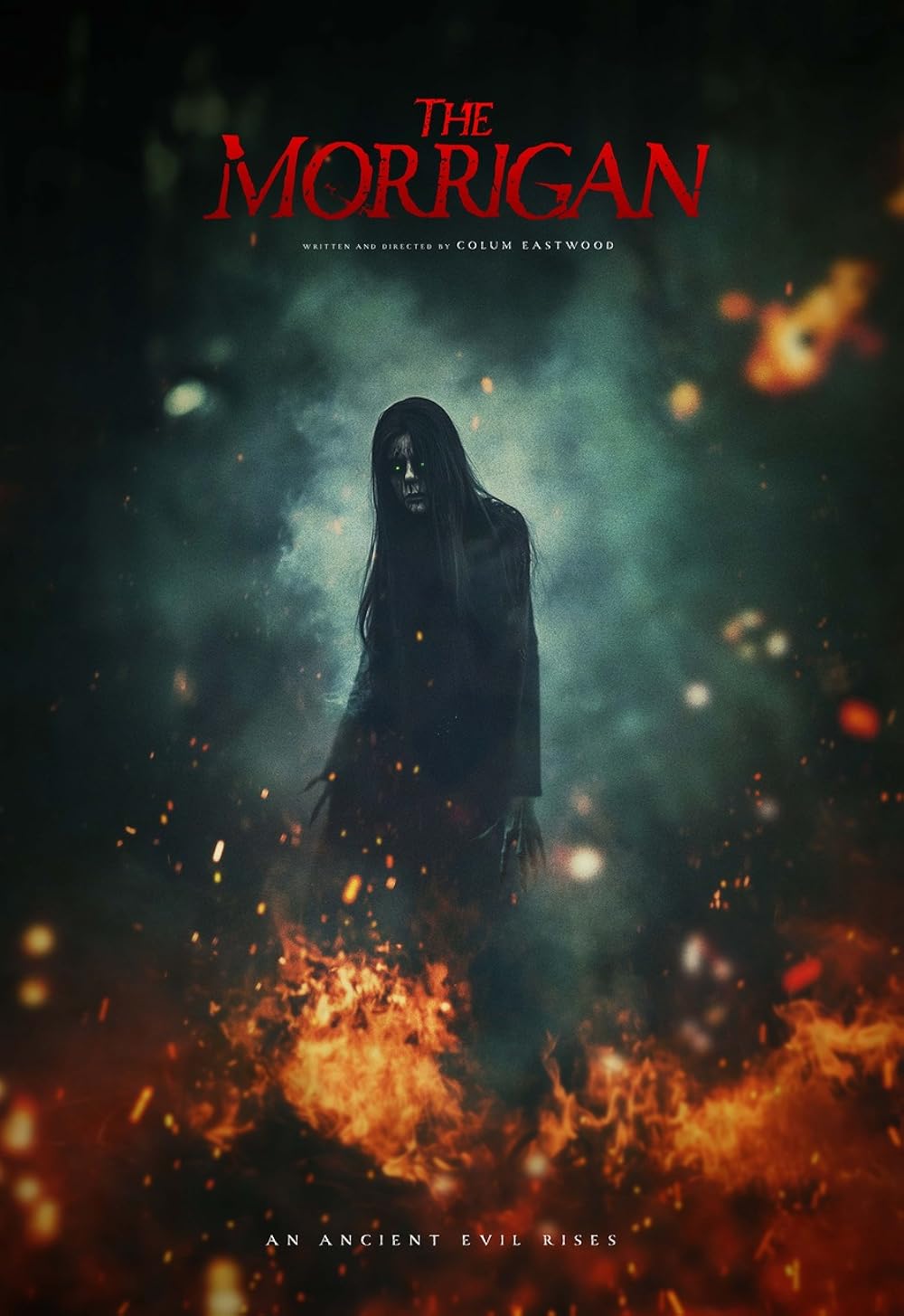
Follows an archaeologist who travels to Ireland to uncover a long-dead tomb. A threat is released and she will have to fight to keep her teenage daughter from falling under the control of The Morrigan, a vengeful “Pagan War Goddess.”
Chuck says:
A shape-shifting entity, referred to as the “Phantom Queen” or the “Triple Goddess,” in Irish folklore, the Morrigan is an entity not to be triffled with. Associated with war and death, she’s been depicted as a woman washing the armor of warriors destined to die. At times, she may appear as a crow, a harbinger of death. Linked to the health of the land, she is said to have affected the outcome of wars, encouraging warriors to commit deeds of great courage, this fierce warrior strikes fear in those she fights with her fury and might.
This figure is at the center of Colum Eastwood’s clever horror film, “The Morrigan,” a smart, atmospheric feature that examines gender politics and generational conflict, while delivering a fair share of scares. Briskly told and sustained by its strong cast, the movie relies on old-fashioned thrills, its suspense generated by suggestive lighting, sharp editing and practical special effects. And while the premise hearkens to many a mummy movie, Eastwood’s script contains enough surprises to make it seem fresh, while its portrayal of the abuses of misogyny through the ages, gives the film necessary narrative heft.
Fiona (Saffron Burrows), a professor of archeology, has done extensive research on the Morrigan and is convinced the myth was based on a real warrior. She posits that the “goddess” and her followers took refuge on Annan Island, but were tracked down by an army of men, slain there, and entombed in an underground vault. The board of trustees at her university reluctantly funds an excavation at the site, but only if Fiona’s colleague and rival, Jonathan (Johnathan Forbes) oversees it. This does not sit well, as not only has he taken credit for her work in the past, but has also sexually assaulted her.
Complicating things further, when Fiona’s husband leaves her, she’s forced to bring her teenage daughter, Lily (Emily Flain) along. Petulant and rebellious, she rubs their host Malachy (Toby Stephens) the wrong way, though his teenage son, Sean (Art Parkinson) is soon smitten by her.
Sure enough, Fiona’s hunch proves correct. The Morrigan’s coffin is found and once it is opened by Lily, the vengeful, long dormant spirit is loose to wreak havoc at will, particularly on any men who might cross her.
Before this happens, Eastwood provides us with plenty of background on not just Fiona and Lily, but the others as well. That we are aware of the secondary characters’ motivations and past, adds more intrigue to the story, as it increase our interest. Of course, not all is as it seems, but the key secrets in the story are logical and don’t seem cheap or manipulative when revealed. As such, the film’s third act does not consist of simply a rampage by the titular threat but is buoyed by key revelations that cast things in a different light.
All in the cast give convincing performances, not a tongue in cheek or wink towards the camera in sight. Burrows, Flain, Stephens and Parkinson are all strong, conveying fear and wonder with a sincerity that elevates the material. James Cosmo as Uncle Francis, who has his fair share of secrets, also excels.
Robert Binnall’s eerie cinematography effectively compliments their efforts, while Eastwood wisely doesn’t belabor any of the story’s familiar points. As a result, “The Morrigan” proves to be a worthwhile little shocker, a film that reminds us that Shakespeare’s comment about scorned women is not only accurate an accurate observation but an entirely justified one as well.
3 1/2 Stars