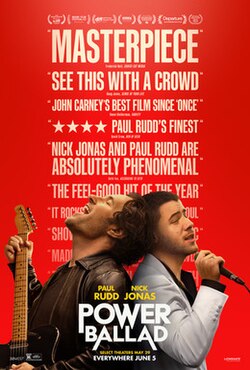
Rick, a washed-up wedding singer, and Danny, a fading boy band star, bond over music and a late-night jam session. When Danny turns Rick’s song into a hit, Rick sets out to reclaim the recognition he believes he deserves.
Chuck says:
Validation and purpose are two of the most vital things that drive us. As most of us struggle through lives seemingly composed of mundane occurrences and numbing routine, we each need the occasional reminder that what we do means something, particularly by the ones we love. And while it’s not uncommon to feel taken for granted as you work your job, pay the bills and occasionally come up for air, the greater danger is being so wrapped up in your own woes that you overlook those that are traveling the same path as you.
John Carney’s “Power Ballad” focuses on a man who’s fallen into this trap. Hardly self-absorbed and a genuinely nice, courteous guy, a chance meeting has set him back on his heels, causing him to question decisions he’s made, playing a hopeless game of “What if…” that can only lead to disappointment and regret. While the vast majority of viewers will not be able to relate to the pop music setting “Ballad” takes place in, most will surely recognize its hero’s plight.
Though once on the cusp of international stardom, being the lead singer in the popular Irish wedding band “The Bride and Groove” has been a pretty good gig for Rick (Paul Rudd). He’s been able to keep his foot in the music game – albeit on the far periphery – and provide for his lovely wife (Marcella Plunkett) and daughter (Beth Fallon). It’s not everything he hoped for, but it’s enough.
That is, until he crosses paths with Danny Wilson (Nick Jonas), former member of a popular boy band. While playing a high-end gig, Wilson, a guest of the wedding party, sits in with the band. This leads to an all-night session in his room with Rick in which the fast friends noodle about, toss ideas at one another and end up writing a song together. The night ends, they part amicably and go their separate ways.
Rick doesn’t give any of this a second thought, until six months later when he hears the song wafting over the radio. Wilson has recorded it and used it as a comeback, the tune becoming so successful that it goes to number one on the charts, snags numerous Grammy nominations and is the impetus for a massive tour. Rick is apoplectic that he’s gotten no credit for his work and, even worse, his family and bandmates don’t believe his claims that he co-wrote a hit as massive and catchy as this.
Rudd’s likable, everyman quality is used to great effect as we can’t help but sympathize with and put ourselves in Rick’s shoes. As he wrestles with the injustice that’s befallen him, the actor is able to keep us in his corner despite the character’s ensuing self-absorbed and, at times, destructive behavior. The casting couldn’t be better, while Jonas does a fine job as well in a thankless role. To Carney and co-writer Peter McDonald’s credit, they don’t portray Wilson as a simple villain but rather a desperate man, tormented by expectations he may not be able to live up to. Fear is his motivator, as he looks at Rick, he sees his own fate if he’s unable to resuscitate his career. He realizes what he’s done is wrong and it’s to Jonas’ credit that we sympathize with him, if only for a short while.
And this speaks to the one fault in Carney and McDonald’s script. While Rick is the main character, the film would have been richer had as much time been spent delving into Wilson and his ever-growing guilt. At only 98 minutes, the movie could have easily included another scene or two focused on his internal battle and would have been the better for it.
As with all of Carney’s music-based movies, this is a heartfelt, effusive exercise in which the songs play a vital role in defining the characters. The main composition, “How to Write a Song without You,” changes in meaning as the film progresses, as each character who sings it interprets it differently. It’s final meaning(s) are brilliantly realized in the film’s last scene, one of the most moving sequences of the year, in which Rick and Wilson sing it simultaneously at two different locales. Carney cuts back and forth between them, each performers’ rendition serving as summation of where they are in their lives, while a key revelation occurs at a third locale.
Carney never disappoints, masterfully manipulating the audience to identify with his characters and feel his songs as they do. In the end, “Ballad” proves to be Rick’s personal odyssey as his doubts regarding his life choices lead to an exile of sorts. Only when he’s ing reminded of what’s truly important to him does he see the path back home. Unashamedly romantic and sentimental, this is a poignant reminder that the lives we live are the songs we sing and if they are heard by those we love, that’s all the audience we ever need.
3 1/2 Stars