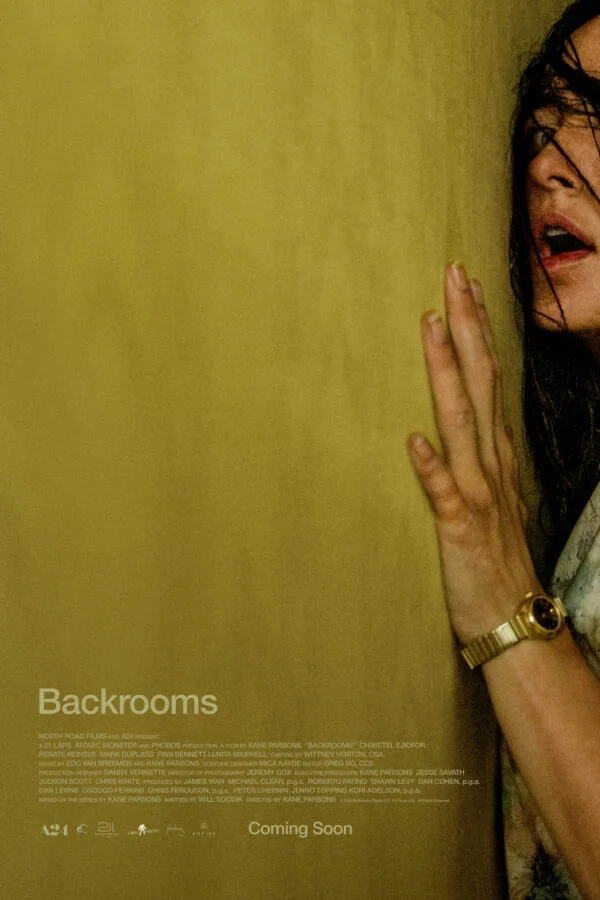
After a therapist’s patient disappears into a dimension beyond reality, she must venture into the unknown to save him.
Chuck says:
There are some interesting ideas in Kane Parsons’ “Backrooms,” a low-budget sensation that’s bringing in big box office for its studio A24 Films. Having generated buzz at various film festivals and based on a series of short films by its director, the movie raked in $81 million during the first weekend of its release. Whether that first wave of curious (gullible?) viewers will spread positive word-of-mouth remains to be seen. Unlike its genre rival “Obsession,” a far superior, more straight-forward film that’s defying expectations by seeing its grosses increase over subsequent weekends, “Backrooms” is awash in half-formed ideas and a frustrating degree of ambiguity that’s supposed to come off as arty and deep.
Clark (Chiwetel Ejiofor) is a lost man, floundering through life. Saddled with debt and running a failing furniture store, he’s filled with rage over his wife having left him and his inability to realize his dream of becoming an architect. His therapist, Mary (Renate Reinsve) does her best to get him out of his rut but she’s also grappling with her own trauma, dealing with her mentally ill mother and the ramifications of a dysfunctional childhood.
Needless to say, things take an unexpected turn one day when Clark, trying to track down an electrical short in the basement of his store, walks through one of the walls. He emerges in a dirty yellow nightmare of seemingly endless rooms and mishappen doors, all dingy and worn, incessantly humming fluorescent lighting casting an abrasive pall over it all. Mary is incredulous when Clark shares the knowledge of his discovery at their next session, causing him to leave in anger, intent on finding proof. When days pass and he fails to return, she goes to the store to investigate and discovers the mysterious portal, passing through it in an effort to find him.
Parsons’ deliberate pacing is initially intriguing but ultimately proves taxing. Granted, his intent may be to place the viewer in his characters’ shoes but it’s an approach that backfires horribly, tedium setting in rather than a sense of terror or suspense. What with its winding, intersecting staircases and halls to nowhere, the production design is engaging to a certain extent, the drawings of M.C. Escher an obvious influence. As fascinating as it is, it too ultimately loses its appeal.
Much of the advice Mary provides relates to the “paths” we take in life, repeated patterns of behavior becoming traps. With this theme being mentioned repeatedly, it becomes apparent the titular location is Clark’s mind, an ouroboros like nightmare from which there is no escape. Experts in Freudian Psychology will have a field day with the many metaphors that appear regarding the id, ego and super-ego, especially when an 8-foot-tall version of Clark appears, dressed as a pirate with overlarge eyes.
Credit the two leads for giving their all, neither of them holding back where conveying their characters’ trauma is concerned. Hyper-ventilating and wide-eyed looks of disbelief never played as well as they do here.
As for the conclusion, well let’s just say it’s an ending…of sorts. Just what Phil’s (Mark Duplass) role, a curious observer of this netherworld, is I can’t begin to tell you. Parsons has threatened us with sequels to his debut feature, stating he sees this as a franchise with endless possibilities. One might be to give us a film with more narrative meat to it than simply a collection of half-formed ideas. “Backrooms” may be tops at the box office for the moment. As for me, it reminds me of a certain emperor who was very proud of his new clothes.
2 Stars