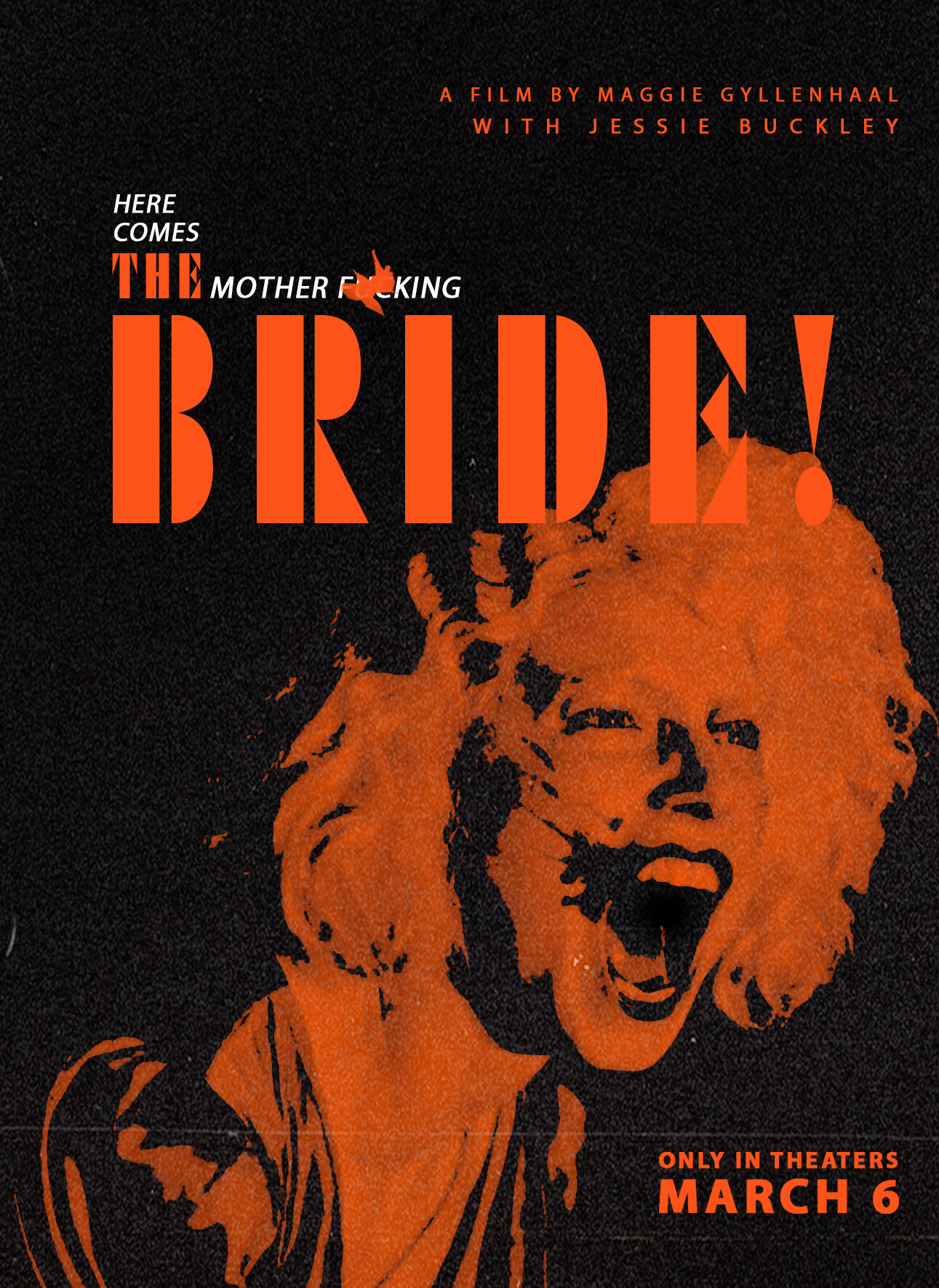
In 1930s Chicago, Frankenstein asks Dr. Euphronius to help create a companion. They give life to a murdered woman as the Bride, sparking romance, police interest, and radical social change.
Pam says:
Maggie Gyllenhaal takes on an ambitious dual role as writer and director in this reimagining of the Frankenstein mythos, but the result is an overburdened, tonally erratic exercise in style over substance. What appears to aim for a statement on feminism, vengeance, and existential longing instead collapses under the weight of surrealist indulgence, jarring shifts in tone, and gratuitous violence that overwhelms any coherent thematic through-line.
Gyllenhaal introduces us to Mary Shelley (Jessie Buckley), rendered in stark black-and-white, long deceased yet restless. She seeks a corporeal return and selects Ida, apparently a mobster’s “side piece” as her vessel. Buckley’s dual performance is the film’s most compelling element as she navigates Shelley’s verbosity and Ida’s fragmented confusion with impressive dexterity. This provocative possession, exploding like a volcano, results in Ida’s death and, thanks to the next act, her resurrection.
Enter Frankenstein (Christian Bale), portrayed as a creature defined less by menace than by aching loneliness. His quest for companionship leads him to the mad scientist Dr. Euphronius (Annette Bening), and together they exhume Ida’s body to create a bride. From here, narrative cohesion begins to unravel. The resurrected woman possesses neither a stable identity nor a clear arc. She oscillates between Shelley’s articulate dominance and the vulnerability of a displaced soul searching for origin and meaning.
Compounding the confusion are elaborate, surreal interludes: musical numbers, cinematic meta-moments inside movie theaters, and ballroom sequences featuring Frankenstein’s idol, Ronnie Reed (Jake Gyllenhaal), evoking a Fred Astaire aesthetic. These sequences are visually striking but narratively unmoored, contributing to a fractured tonal landscape.
Meanwhile, Detective Jake Wiles (Peter Sarsgaard) and Myrna Mallow (Penélope Cruz) pursue the fugitive pair in a subplot that evokes a grotesque Bonnie-and-Clyde pastiche. Instead of bank robberies, the monster couple races from Midwestern theaters to New York cinemas, chasing fleeting glamour while leaving violence in their wake.
That violence is the film’s most troubling miscalculation. Its graphic, chaotic brutality is so relentless that it drowns out whatever commentary the film attempts regarding injustice or female agency. The tonal whiplash, veering from ironic humor to shocking carnage, creates a dissonance that undermines emotional investment.
Technically, the film excels. The makeup is extraordinary, the production design richly textured (despite occasional period inconsistencies), and the cinematography ambitious to a fault. But aesthetic sophistication cannot compensate for a lack of structural clarity. As the oft-cited filmmaking maxim attributed to Robert Redford suggests: tell a good story well. Here, that foundational principle is lost amid stylistic excess.
1 1/2 Stars
Chuck says:
In the interest of full disclosure, I need to say upfront that I’ve seen James Whale’s “The Bride of Frankenstein” more than any other movie. It never ceases to entertain, the filmmaker’s inventive combination of gothic horror, dark humor and fairy tale elements are as fresh today as they were 90 years ago. Driven by a touching performance by Boris Karloff as the monster and a delicious turn from Ernest Thesinger as the fay but maniacal Dr. Pretorious, it’s a lean, punk entertainment that doesn’t age, a movie that remains ahead of its time in terms of its distinct aesthetic and sensibility. The ground-breaking make up of Jack Pierce and the brief iconic appearance of Elsa Lancaster in the titular role makes for a timeless classic, a 75-minute entertainment that manages to frighten, amuse and move the viewer in a narratively economic, efficient manner that’s regrettably a relic from a bygone era.
Despite my affinity for Whale’s film, I kept an open mind regarding Maggie Gyllehaal’s “The Bride,” a reimagining of the Universal classic. Yes, there were bound to be changes made. Yes, there would be alterations to the characters. And, I would have to make the concession that the era of today would have a profound effect on updating the movie’s theme.
Unfortunately, nothing could have prepared me for the mess of a movie this is. Overwrought, nonsensical and abrasive, this is a disjointed mish-mash of half-baked ideas that never mesh, coherence being just so much collateral damage in Gyllenhaal’s pursuit of “art.” Hobbled by disparate tones, the film never finds its footing, the director wanting to say so much, yet winds up saying nothing.
While the setting may be Chicago in the 1930’s, the action kicks off in some sort of purgatory in which the tortured spirit of Mary Shelley (Jessie Buckley) laments over not being allowed to tell the story she intended to tell. A roiling mass of fury, she sets out to champion the cause of repressed women by possessing Ida (Buckley, also), a moll to a Windy City gangster. Why her or how this happens is never explained. This is the first of many inexplicable plot devices the viewer is supposed to accept without question.
Soon, Ida is spouting off about independence and exposing the local mob boss, in an English accent no less, and, wouldn’t you know it, winds up dead as a result. Fortuitously, the Frankenstein monster (Christian Bale) has just blown into town to pay a visit to Dr. Euphronius (Annette Bening). Seems the scientist has some radical theories revolving around electric currents and reanimating dead flesh. The Creature has come to request that she, through her methods, make him a mate.
Ida is fresh enough to be the subject of this experiment and is soon brought back to some version of life. Suffering bouts of amnesia she’s still contending with Shelley’s voice in her head and questions regarding what she’s become. Soon she and Frank- the name the Creature is regrettably referred as – are on the town and in trouble. Killing two would be rapists, the monsters are soon on the run, a dogged detective (Peter Sarsgaard) and his Girl Friday (Penelope Cruz) on their tail.
The dialogue and sound design are cranked to 11 throughout, the aural assault just one of the film’s many abrasive elements. Gyllenhaal moves her camera for no good reason, it often placed too close to her characters, while the aggressive editing makes for a discordant aesthetic. Sitting through this movie is an unpleasant experience from beginning to end, it’s sound and fury approach, ultimately a chore.
Adding to its jarring nature are the story’s many inexplicable events. Apparently, the monsters are able to project their thoughts and actions into others, as evidenced by an elaborate dance sequence in which they mentally commandeer the bodies of others. They can also project their images and thoughts on to movie screens and other visual sources. Why? Got me!
The setting is a construct of Gyllenhaal’s own, events and inventions from a variety of time periods at play in the “1930’s.” Apparently, everyone knows of the existence of the Frankenstein monster, his tortured history common knowledge. Scenes of terror, violence and comedy trip on the heels of one another, a consistent tone absent throughout, while the filmmaker’s lack of understanding regarding the characters’ history and their place in pop culture proves damning. When the monster breaks into a song and dance routine to “Puttin’ on the Ritz,” you’re not sure if Gyllenhaal is pulling our leg or if she hasn’t seen “Young Frankenstein.”
The veteran cast does what they can to salvage this mess and if nothing else, none of them embarrass themselves. Buckley is fully committed to her role, her energy never flagging in the face of one exhausting scene after another. Bale, the consummate professional, brings a naivete to the monster, his sympathetic portrayal a marvel. They each deserve to be in a better movie. Bening effectively injects dark humor throughout, while Sarsgaard and Cruz demonstrate a surprising degree of chemistry. Jake Gylenhaal also appears as Ronnie Reed, a Fred Astaire-like performer Frank has an affinity for.
The tragedy of the film is that Gyllenhaal’s message, which she is obviously desperate to convey, is lost amid the tumult. Her radical view of feminism is vital but misconstrued while any comments she may have regarding the media, identity, our love of the movies and the duality of love are obscured by her approach. In the end, “The Bride” is a reflection of the Frankenstein monster, a collection of clumsily stitched together parts that lack cohesion, failing to communicate despite the best of intentions.
1 1/2 Stars