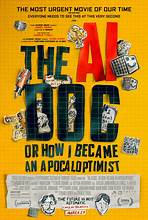
A father-to-be tries to figure out what is happening with all this AI insanity.
Chuck says:
According to one group of experts, artificial intelligence is a tool that, despite being relatively new, is already out of control. It will soon be smarter than we are as it continues to learn at a phenomenal rate as well as duplicate itself. It has become an entity that has learned self-preservation and cannot be turned off. It will soon control every system around the world, those that regulate finance, business, energy, transportation and health. It has more power than all other forms of technology ever invented, combined. As a result, some of these experts don’t think their children will reach high school, referring to its invention as the “last mistake we’ll ever get to make.”
Yet another group of experts think that AI will lead to a glorious cultural and social revolution that will change everyone’s life for the better. They envision a world in which a cure for every disease is found. Problems such as hunger, the energy crisis, and access to clean water will be a thing of the past. This tool will direct and instruct us how to mine minerals from space that will lead to further breakthroughs. With AI robots and other advances, humans will no longer have to work, free to develop themselves to their greatest potential. Many of them say there is no other time in human history that they’d rather live than right now, referring to our era as an “Age of Abundance,” a “post-scarcity world” soon to be realized.
Of course, which of these scenarios you embrace all depends on which glass perspective – half empty or half full – you subscribe to. Filmmaker Daniel Roher is in the former but desperately wants to be in the latter. Unfortunately, he’s no Pollyanna, his questions and doubts undercutting the fleeting feelings of optimism he experiences.
“The AI Doc: Of How I Became an Apocaloptimist” chronicles his efforts to ensure himself that everything is going to be all right. While the majority of us are likely experiencing undue stress thanks to this technological upheaval, Roher’s anxiety is exacerbated by the fact that he and his wife, are expecting their first child. The nagging notion they’re doing their child a disservice by bringing him into our tumultuous world, keeps him up at night.
Roher’s quest for reassurance prompts him to interview a wide variety of experts in the AI field, makeing up the bulk of the movie. That this group, which consists of the founders of Open AI, Anthropic, Google Deepmind, as well as cutting-edge inventors and professors, cannot come to a consensus as to what AI is, is a cause for concern.
Roher frontloads the film with those espousing the direst predictions, hoping to leave the viewer with a sense of hope after hearing a collection of more positive outlooks at the end. What emerges is the question of “Power vs. Peril,” that is, will there be more benefits than negatives in an AI-driven world. Many of the talking heads find a sense of middle ground where this is concerned.
Again, every viewer’s take-away will vary and while I want to embrace the more favorable outlook, the information Roher has culled makes that difficult. I have no doubt that great things will come from AI, but in the end whether those will outweigh the problems that result from it all come down to one thing – humans. When it’s suggested the key to our survival is the creation of an international organization to ensure AI be used responsibly and for the benefit of all, I couldn’t help but think that, as Warren Zevon advised, we should begin enjoying every sandwich.
3 1/2 Stars