In adapting Jordan Harper’s novel, “She Rides Shotgun,” a couple of happy accidents took place during its prolonged production. A change of locale and the discovery of a brilliant young actress helped transform this story of urban crime into something more meaningful and poignant. Charting the cross-country journey of recently paroled convict Nathan Mcclusky (Taron Egerton) and his estranged ten-year-old daughter Polly (Ana Sophia Heger), the film examines how these two come to respect and love one another as members of a crime syndicate as well as a dogged police officer try to bring them in.
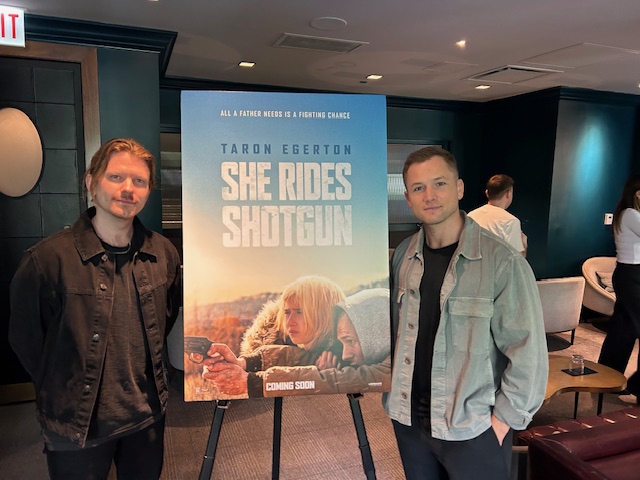
I recently sat down with Egerton and director Nick Rowland to discuss the making of the film, a wide-ranging, easy conversation that covered everything from how the two leads approached their roles to how a dramatic change in the film’s location changed to tone and intent of the movie.
I started by asking Egerton about the challenges he faced bringing his tough guy character to life, noting that he struck me as an actor who is easily bored and always on the lookout for something different.
“You’re absolutely right,” he answered with a laugh. “I think I like things that are distinct from one thing to the next. I often look for things that have a good logline, something you can sum up in a sentence, something that will get me to say, ’I fancy watching that!’ I read the script about two years ago and I thought ‘They’re not going to let me do this.’ I thought it would go to an actor ten years my senior or an actor that didn’t have to work to be tough. But actually, I think it was my insecurities that made me right for the role.”
Egerton is joined on screen by relative newcomer Ana Sophia Heger, a young dynamo that steals every scene she’s in. I asked Rowland how he came about casting her in the role.
“We were so lucky to find her. We shot the film in 25 days, so we had to have someone emotionally robust and someone who was beyond her years and with Ana we found that. When we got to the readthrough stage it was evident she was the one. I remember Taron pulled her aside and said to her, ‘Don’t worry if you’re nervous. Everyone gets nervous.’ She said, ‘I am nervous, but I know I’m ready.’ I could work with her the way I worked with Taron or any other actor. I thought I would have to come up with a different approach to direct such a young performer, but it quickly became evident that wasn’t necessary.”
Egerton found that he too was surprised by his young co-star. “I anticipated that I would have to take a more nurturing role off set,” he said, “but she has a prodigious understanding of her craft and she’s hungry for it. So many child performers feel coached or manufactured and the thing that Anna has is an intrinsic understanding of the scenes she’s in and she’s a great listener. She has this innate ability to be present in the scene.”
While the novel is set in Los Angeles, budget constraints forced a change, Rowland deciding to shoot the bulk of the film in New Mexico. As a result, the director took a different approach to the material, evoking elements of the western along the way.
“It was honestly so thrilling coming from the UK to New Mexico,” he noted. “I remember texting Taron the first time I saw a tumbleweed. Because to us it’s mythic. Honestly, it was one of the biggest creative changes I made because the book is so entrenched in the atmosphere of Los Angeles. I was excited by the changes the environment provided to us.”
“And it felt like the universe was making the decisions for us,” added Egerton. “If there is a state most associated with the western, it’s that one. We wanted it to feel barren and isolated. The novel reads like a western. I always thought of Nate as a dead man walking which is a perfect fit for the genre. It’s in the spirit and fiber of what the story is. We wanted things to feel initially imposing about him but then as the film goes on, you chip away at him to find out how vulnerable he is. The story is a simple one, but the challenge was to make Nathan interesting. It could have been written as a typical hero, but he is the most reluctant hero. At no point does he want to be fighting or making any decisions. He just wants to be in the background. But of course, like so many of us, circumstances force him to step up.”