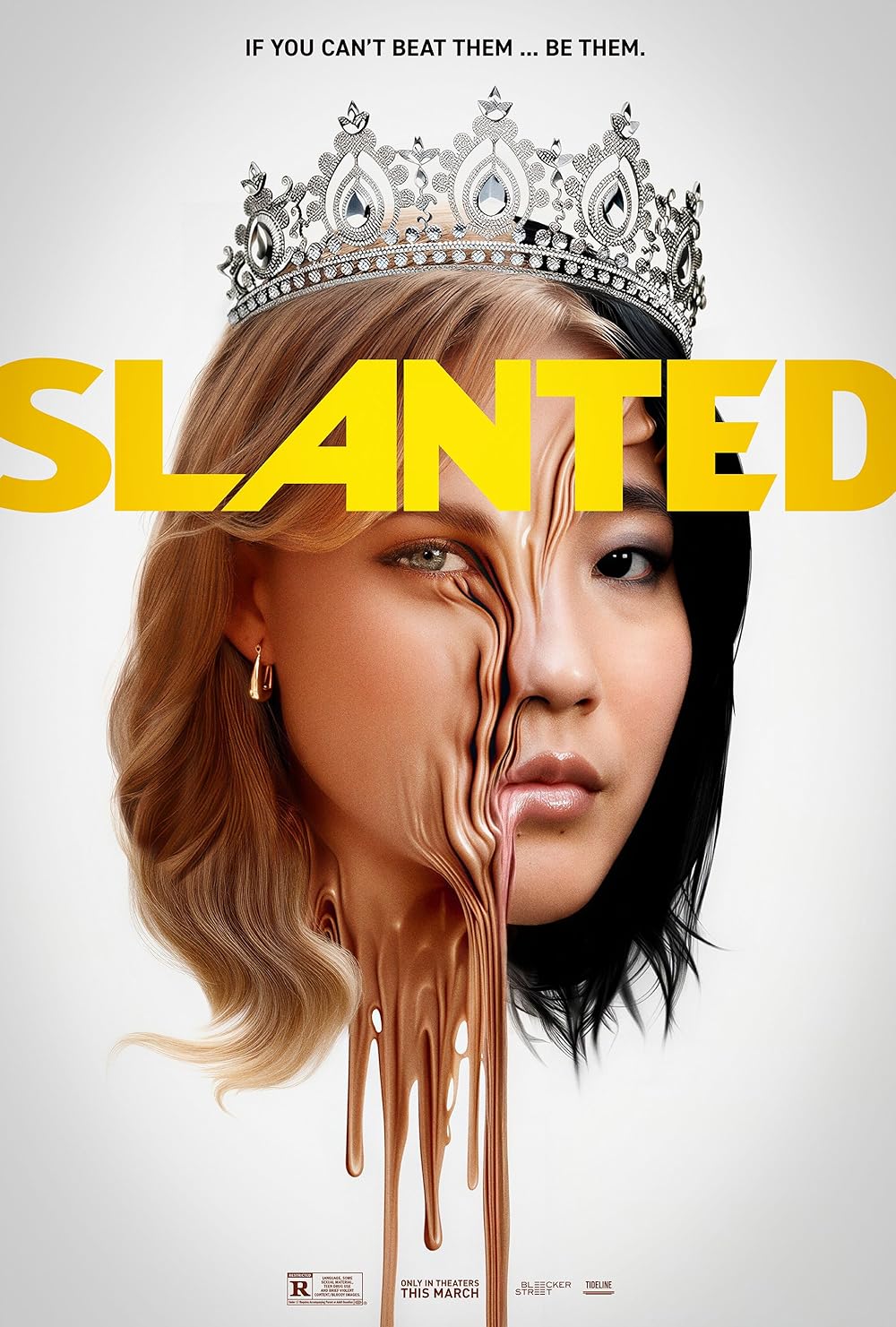
An insecure Chinese-American teenager undergoes experimental surgery to appear white, hoping to secure the prom queen title and peer acceptance.
Chuck says:
Hobbled by a modest budget, Amy Wang still manages to effectively deliver a pointed social satire with “Slanted,” a hybrid of “The Substance” and “Mean Girls” that examines the pitfalls of cultural assimilation. Through the eyes of its sympathetic protagonist, the film manages to address not only the pressures facing modern young women, but also the Catch-22 social dynamics immigrants who come to America must contend with. Though the script would have benefitted from a sharper edge and some of its themes could have been developed further, Wang deserves credit for bringing these issues to the table at a time when cultural identity and what it means to be an “American” are at the forefront of our national conversation.
That Chinese-American Joan Huang (Shirley Chen) is confused about who she is and ought to be is understandable. Having come to the United States with her parents at the age of six, she’s been inundated with images of female Caucasian perfection. Pictures from magazines of white models in their made-up glory are plastered on her bedroom wall and she’s no stranger to using an image-filtering app from the Ethnos company that makes her appear more “white” in the pictures she posts.
She’s such a frequent user that the company reaches out with a “special offer.” They provide a service in which all physical attributes of your cultural heritage are wiped away until you appear to be “white.” Having suffered bullying at the hands of the mean girls clique led by the icy Olivia (Amelie Zilber) and desperate to be Prom Queen, she undergoes the procedure and emerges as Jo Hunt (McKenna Grace). That the kids at Clarksville High School are immediately taken with her is an understatement. That Joan’s parents (Vivian Wu and Eric Lang) are shocked at the seeming stranger that walks through their door, even more so.
The mean girls’ antics Joan is subjected to are old hat by now but the cultural issues Wang puts under the microscope benefit from their timeliness. Though a bit obvious, a music video set to the song “It’s Good to Be White,” replete with images of upper middle-class happiness, is effective, as are testimonies Joan/Jo hears from those who’ve undergone the transition. Apparently attending at Michael Bubble concert is a key step in achieving bliss as a white person. All of this is done with tongue planted firmly in cheek, the dark irony of this conceit effectively conveyed.
The most refreshing aspect of Wang’s script is the portrayal of Joan’s parents. After getting over their initial shock of their daughter’s transformation, they admit to her their own feelings of confusion upon first arriving in the States. Her father looks back at his “cowboy” phase with shamed regret, while her mother comes to realize that dealing with these issues as adult is quite different than trying to sort through the cultural shift as a little girl. These moments give the film a sense of validity that’s invaluable.
Of course, actions such as those Joan takes come with a cost, so it’s no surprise when things go south at the prom for Jo. Yet, Wang has another card up her sleeve, delivering a nice twist, providing our troubled heroine with an unexpected savior, who sheds even more light on her situation.
Ultimately, the irony of all she’s done dawns on Joan. Having stated that “I don’t want to be a stereotype” as one of her reasons for undergoing the procedure, she realizes too late that this is exactly what she’s done. Ultimately, having become a vacuous, blonde like Olivia and her peers doesn’t bring her the happiness or acceptance she sought. Her father’s observation that “Being Chinese is what made you special,” hits home only after she’s walked in the others’ shoes.
In the end, “Slanted” points out that the only way to find peace is to become “your own American,” one that embraces elements of both your original and new countries. That some would think this notion, upon which our country was based on, is a radical idea is not only ironic, but awfully “white.”
3 Stars