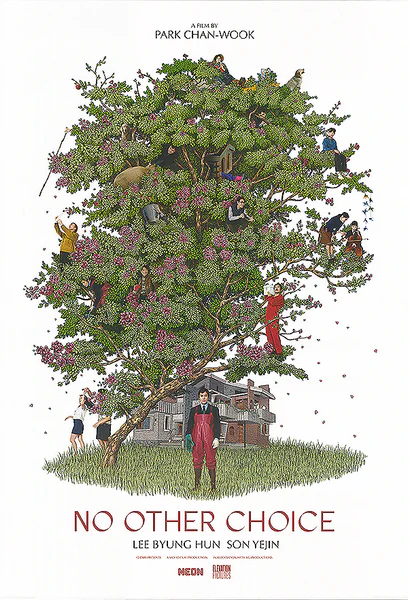
After being unemployed for several years, a man devises a unique plan to secure a new job: eliminate his competition.
Chuck says:
Man-su is living the dream. Having worked at the same paper plant for the last 25 years, he’s achieved a sense of security and pride you can’t put a price on. He has a loving wife, two healthy children, two dogs, and a spacious home. He couldn’t be happier. That is, until disaster strikes. When an American corporation purchases the company where he works and begins cutting back on staff, Man-su finds himself unemployed and desperate. Jobs are hard to find at his age but he manages to be considered as a finalist for a position that will solve all his problems. But how will he ensure he gets the job? Simple, he’ll just kill the competition.
Such is the premise of Park Chan-wook’s “No Other Choice,” a timely dark comedy that speaks to modern economic concerns. Buoyed by strong performances, the screenplay would have benefitted from some judicious cutting. Sagging badly in the middle, the film suffers from disparate tones and narrative constipation. Thankfully, it manages to right itself, delivering a wonderfully ironic conclusion that drives home the ultimate futility of all we’ve witnessed.
Vowing to get a new position in three months, Man-su (Lee Byung-hun) finds himself backed into a corner. His wife, Miri (Son Ye-jin), has gone back to work after giving up many of her luxuries and cutting the family budget to the bone. And while the threat of foreclosure is of great concern, the damage to Man-su’s pride proves most devastating. Necessity may be the mother of invention, but desperation is its twin. After an interview for a job that would solve all of his problems doesn’t go well, he reasons that his chances of getting it would increase if he were to eliminate his competition.
Like Man-su, we come to realize his targets are victims of economic forces beyond their control. Gu Bummo (Le Sung-min) has lost himself in drink and self-pity, while Go Sijo (Cha Seung-won) is a gentle soul, equally adrift and uncertain of his future. While we see this common thread, Man-su is blind to this, able to rationalize his behavior and carry out his plan, though not with the sort of precision that ensures easy execution or clean up. And while Park attempts to inject a bit of humor in each of the killings, the fact that Man-su goes through with them and becomes more exacting as he continues alienates him from us. It also effectively speaks to the corrosive nature of being without purpose has on our morality.
Equally intriguing is the examination of the ripple effects of Man-su’s firing on his wife. Miri finds herself making ethical compromises she never would have considered. When she eventually guesses what her husband has been up to, the decision as to whether to turn him in or cover his tracks in an effort to eventually regain their way of life weighs heavily upon her.
Material such as this requires a much faster pace than what Park employs here. Far too much time is spent on Gu’s travails and Man-su’s interactions with him. Their prolonged conversations results in an ineffective slapstick sequence involving a just-out-of-reach pistol which saps the potential assassination of any tension, lapsing into tedium. Thankfully, Man’s next two targets are dealt with more efficiently, the movie regaining some of its initial momentum.
The titular phrase is employed throughout the film, a lazy bit of reasoning used by Man-su, those who would employ him and the representatives of the American corporation when asked about the mass firings they’ve initiated. It’s a callous, deflective response that reflects a lack of ethics and a willingness to sacrifice the well-being of others in the pursuit of personal gain.
It should come as no surprise that Man-su acts as he does. Capitalism and its infectious, seductive nature are the primary villain of the piece, an overwhelming force impossible to fight. Or resist, for that matter. Man-su and Miri may be able to justify their actions, reasoning their behavior is the result of their survival instinct. Yet, the power of “Choice” is that it makes it obvious there are other avenues that can be taken and that the true cost of ignoring them is far greater than any monetary gain.
3 Stars