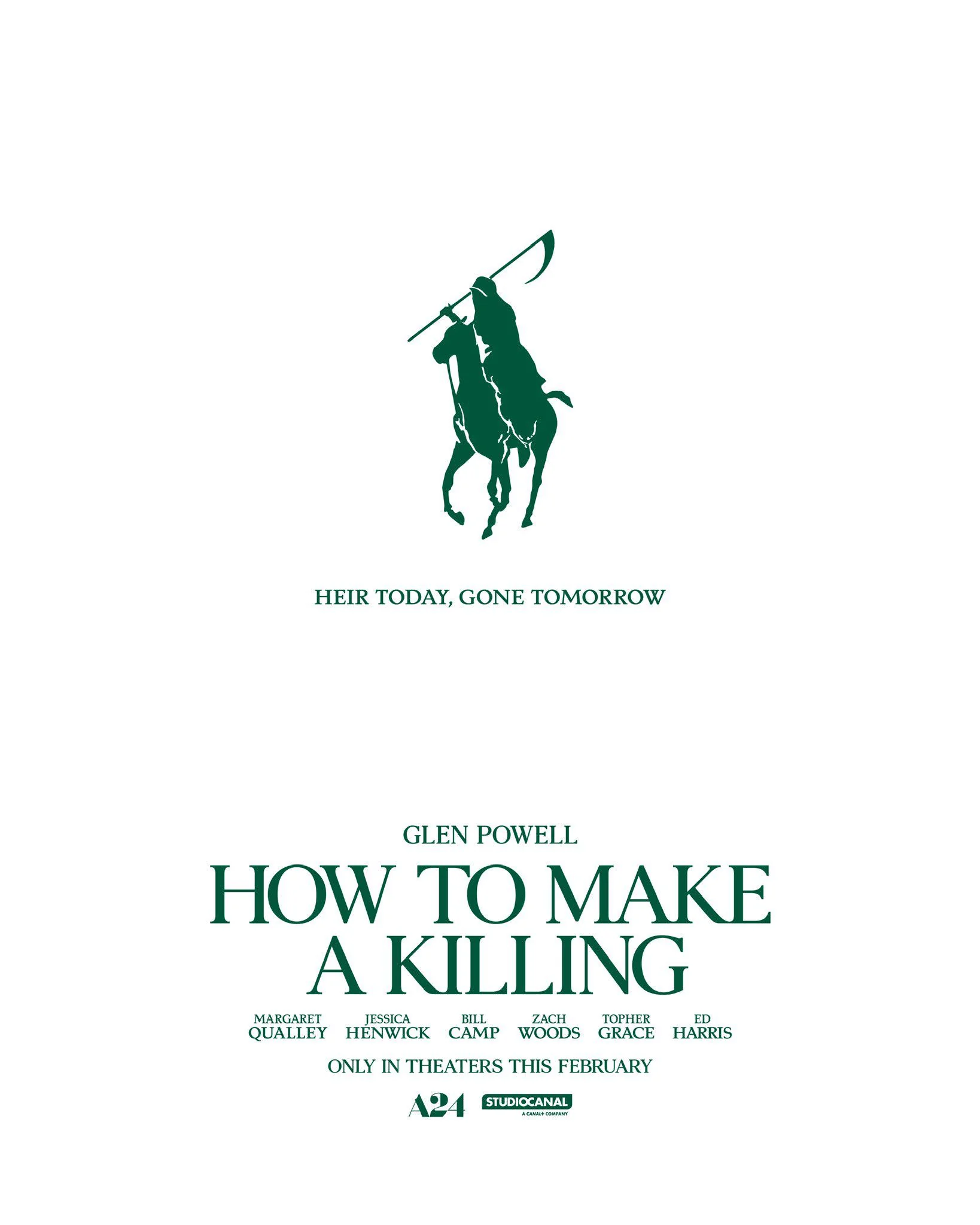
Disowned at birth by his obscenely wealthy family, blue-collar Becket Redfellow will stop at nothing to reclaim his inheritance, no matter how many relatives stand in his way.
Chuck says:
A modern update of the classic English film “Kind Hearts and Coronets,” John Patton Ford’s “How to Make a Killing” manages to finally give Glen Powell a role he can make his own. With the exception of Richard Linklater’s “Hit Man”, the actor has labored in the shadow of Tom Cruise (“Top Gun: Maverick”), and been saddled with character clones in a reboot and a remake (“Twisters” and “The Running Man”). The “next big thing,” hasn’t had much of an opportunity to prove his movie star mettle and while his work in “Killing” won’t guarantee him a star on the Hollywood Walk of Fame, he seems more at ease here than he has previously.
From an early age, a sense of entitlement has been hammered into Becket Redfellow (Powell). His mother, Grace (Nell Williams), the daughter of billionaire Whitelaw Redfellow (Ed Harris), was disowned by her father after getting pregnant out of wedlock. Forced to work at the New Jersey DMV, she makes sure Becket is aware that while they’ve been ostracized, he’s still legally in line to inherit the family fortune. This is a notion he puts out of his mind after she dies at a young age.
Content to live an ordinary life working at a Manhattan haberdashery, his yearning for the fortune is reawakened when he crosses paths with his childhood crush, Julia Steinway (Margaret Qualley). Choking on the silver spoon she was born with, Becket’s well aware she’s out of his league, but if should manage to inherit the Redfellow fortune…
His desire for Julia sets in motion out anti-hero’s plan to knockoff the seven other Redfellows who are in line to inherit the money before him. With the exception of his benevolent Uncle Warren (Bill Camp), they’re a broadly drawn lot, each so heinous you can’t wait to see what sort of end awaits them. Ford wisely doesn’t make any of the murders overtly violent or gruesome, opting instead for ironic, darkly comedic deaths.
Television vets Topher Grace and Zach Woods provide broad humorous turns as cousins Noah and Steven, the former an ego-driven artist, the latter an evangelical fraud. As Becket’s love interest Ruth, Jessica Henwick provides a sense of calm and normality as the only ethical person in the film’s amoral universe, while Qualley, in full femme fatale mode, looks as if she stumbled out of a Robert Mitchum film noir. Each of these actors provide solid support, knowing full well this is Powell’s movie and making the most of their moments on screen.
As for the star, he displays a degree of confidence and calm that’s been missing from his previous work. Self-conscious and a bit too broad in many of his earlier films, there’s an ease about Powell here that not only makes for a better performance, but allows him to make a connection with viewers. The relationship between a performer and the audience is based on their ability to identify with that person on screen, to believe there is some personal connection or commonality between them. As Becket, Powell takes the first step towards doing this, an approach he’d be wise to continue in future films.
3 Stars