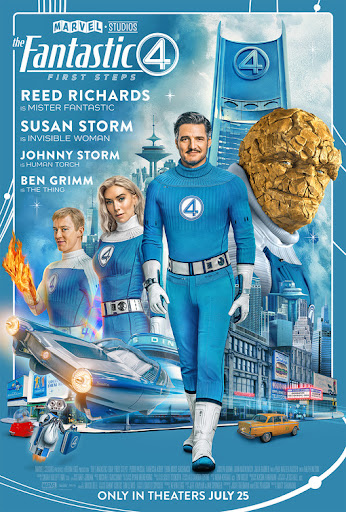
Forced to balance their roles as heroes with the strength of their family bond, the Fantastic Four must defend Earth from a ravenous space god called Galactus and his enigmatic Herald, Silver Surfer.
Chuck says:
One of the more vexing things for fans of Marvel Comics is the inability to successfully translate the initial property of the four-color universe to the big screen. Hitting newsstands during the fall of 1961, “The Fantastic Four,” was the first superhero-based comic created by Stan Lee and Jack Kirby, a book that would quickly amass a devoted following, the success of which inspired the creative duo to dip their toes deeper into the genre their chief rival, DC Comics, specialized in. Setting the template for the Marvel Comics line, the title featured characters more human than super, flawed people who come to realize the strange powers they’d inherited were just as much a curse as a blessing. Without Reed Richards, Ben Grimm and Sue and Johnny Storm, it could be argued that Spider-Man, Iron Man and their brethren would have never seen the light of day.
Because of its place in Marvel’s history, the expectations for a film version of the group’s adventures have always been high and never met. The low-budget 1994 version was so misguided it was never released, while the 2005 and 2007 entries were serviceable but hardly worthy of the FF’s adventures. As for the 2015 attempt, had it also been unreleased it would have been a boon for audiences and critics alike.
So, with the property’s tattered film history and Marvel in dire need of a hit, the pressure is on director Matt Shankman to deliver on this latest attempt to do the characters justice. Thankfully, he understood the assignment, his “The Fantastic Four: First Steps” proving to be a vibrant jolt of fun, a movie that never takes itself too seriously while treating the property with the reverence it deserves.
Taking place on an alternate world where Captain America and his peers do not exist, what’s striking is the glossy, retro-futuristic 1960’s aesthetic Shankman employs. Reminiscent of the original comic, this is a time of transition, as this world is entering an era of great hope and exploration. The Fantastic Four represents this conceit and all its possibilities, having become media sensations since debuting four prior, during the aftermath of an ill-fated trip to outer space. Upon returning from the cosmos, Reed Richards (Pedro Pascal) is granted to ability to stretch to untold lengths, his wife Sue (Vanessa Kirby) is able to turn herself and other things invisible, her brother Johnny (Joseph Quinn) is bestowed with power to fly and burst into flames, while Ben Grimm (Ebon Moss-Bachrach) is given incredible strength but is radically altered physically as a result.
Rather than lording over the people of Earth, they’ve devoted themselves to helping all they encounter. As a result, the public has embraced them, the group’s sincere benevolence making them universally loved. However, this is put the test when a herald from space, the Silver Surfer (Julia Garner), arrives to announce the coming of Galactus (Ralph Ineson), a massive alien who consumes whole planets for sustenance. Looking to their saviors for salvation, the people of Earth turn on the group when it is revealed they are unwilling to make a particular sacrifice to save them from the space being’s wrath.
One of the hallmarks of the “Fantastic Four” comic were the interactions between the titular characters. Though differences would often arise between them, their unity as a family was always seen as genuine and heartfelt. This, as well as the grand cosmic adventures they undertook, separated that series from the rest, making it unique within the medium.
Both elements are present here, executed with a style and artistry that elevates it above the also-ran versions that proceeded it. The banter between Reed, Sue, Johnny, and Ben is often heated yet there’s never a doubt there’s a sense of mutual love and respect behind it. Pascal, Kirby, Quinn and Ebon-Bachrach capture this perfectly, as if it were all second nature, their interactions having a lived-in quality suggesting a long history between them.
Much like the source material, the script by Josh Friedman, Eric Pearson and Jeff Kaplan focuses on the humanity of the characters. The pressure Reed faces in saving the world, Sue’s ferocity in saving her family, Johnny’s yearning to prove himself and Ben’s insecurities are all present, each brought to life by the actors in an intimate fashion that makes their respective dilemmas relatable.
Long-time fans of the comic will appreciate the deep-cut Easter Eggs that pop up throughout, citing not only the group’s earliest exploits but also reverently alluding to the characters’ creators. More than anything, the movie is a great deal of fun. While so many of Marvel’s latest films have felt a bit too heavy or, at times, directionless, “Steps” provides a hard reset for the entire studio. In setting the story at the dawn of the company’s comics revolution, there’s a sense of renewal, the movie serving as a new starting point for the franchise, one brimming with enthusiasm and excitement.
More than anything, “Steps” is the perfect anecdote for superhero fatigue, it, along with James Gunn’s “Superman” reminding us that these films should be fun as well as hopeful, something each accomplishes with a sincerity likely to please new fans as well as old.
3 1/2 Stars