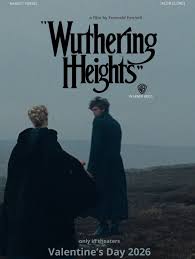
A passionate and tumultuous love story set against the backdrop of the Yorkshire moors, exploring the intense and destructive relationship between Heathcliff and Catherine Earnshaw.
Chuck says:
What a glorious, frustrating mess of a film Emerald Fennell’s “Wuthering Heights” is. The sumptuous production captivates with its broad visually romantic strokes, the director putting her distinctive stamp on the Emily Bronte Classic in using a vibrant and at times brooding aesthetic that’s never less than captivating. And yet, the overall effect is brought low by Fennell’s tendency to go too far, shocking the view for shock’s sake with radical additions and alterations that either produce head-scratching moments or feelings of disgust. The end result is a curious disappointment that, ironically, despite its flaws, still proves haunting.
Much has been made about Fennell’s many changes to Cathy and Heathcliff’s doomed love story. They are so many, in fact, that space prevents me from listing them all. And while some of the alterations help streamline the story, far too many highlight and expand on the sensational aspects of the tale, to the film’s ultimate detriment.
The novel’s basic premise remains the same. Returning from a trip to England, the owner of Wuthering Heights, Earnshaw (Martin Clunes), has brought with him a child of the streets, a ragged boy he gives to his daughter, Catherine (Charlotte Mellington) as a present. She names him Heathcliff (Owen Cooper) after her dead brother, which sets in motion in which the two look after and torment one another over the years as they traipse around the moors and estate.
Time passes, Wuthering Heights gradually falls into ruin and Cathy (Margot Robie) longs to save her father and their home. She gets the chance when she catches the eye of Edgar Linton (Shazad Latif), who has just moved into Thrushcross Grange, a posh neighboring estate, with his sister Isabella (Alison Oliver). They soon marry, Cathy sacrificing her own happiness, leaving behind Heathcliff (Jacob Elordi) for the riches she’ll have at her disposal. However, her former playmate soon leaves, only to return some three years later, rich, handsome and eager to torment his former companion for having spurned him.
Combining Cathy’s brother and her father into one abusive character provides the story with expedience and provides some intriguing emotional tension between Earnshaw and the children. Abusive towards Heathcliff, the scenes between the two when the latter has returned to Wuthering Heights and becomes the owner, the old man still living in the rundown home, have a greater impact. This is true as well between father and daughter, Cathy coming to resent Earnshaw for having allowed his base nature get the best of him, at the cost of her home and happiness.
That Fenell alters Cathy’s purpose for marrying Linton is perhaps the most significant change. Presenting her as a noble sacrifice, wedding out of expedience instead of selfishness, is a desperate attempt to make her more relatable and cast her in a more sympathetic light. Yet, elements of the character’s capricious, frivolous nature still exist, clashing with Fenell’s added traits of benevolence, making Cathy contradictory and inaccessible.
Also of note is the alteration to Nelly (Hong Chau). The loyal servant from the novel has become a duplicitous, manipulative woman who serves as the reason for the discord between Cathy and Heathcliff. Cut from the same cloth as Mrs. Danvers from “Rebecca,” using the character in this way adds nothing of note to the story and robs it of the tragic, bitter irony that keeps the lovers apart.
Unable to curb her most lurid impulses, Fennell repeatedly implements a sordid aspect to Cathy and Heathcliff’s romance in the third act. That they never consummated their relationship in the novel and other adaptations maintains a degree of purity in their connection and contributes to their ultimate tragedy. Portraying them as two base, rutting animals makes the couple and story, common.
And yet, there are Fenell’s striking visuals which, momentarily, sweep you away. The Grange is an ornate dollhouse brought to life, its vast rooms decked out in vibrant, lacquered reds and pinks, its pristine nature, at times, blinding. Countering that is the titular residence, a brooding, dark and dank structure that seems to have been cleaved out of the massive rockface that looms behind it. While the Grange is a home of hope and optimism, Wuthering Heights is a place of death and despair, from which nothing healthy or moral can emerge.
The many gowns and outfits Robie dons are as stylized and striking as the home in which Cathy resides, each gorgeously rendered and reflective of her moods. Equally striking is a shot of her wedding gown with its vast train spread behind her as she walks across the heath to her new life, a showstopping scene of many implications.
All of these elements are so well done, you wish they were in the service of a better movie, perhaps a new version of “Dracula.” I couldn’t help but think during the film’s darkest moments, including a shot of a river of blood flowing off a bed, were Fennell to employ similar resources and her provocateur’s flair to the seminal horror story, it could be quite something. To be sure, in the end it may be as inconsistent as this movie, but her visual and thematic approach would be more in keeping with Bram Stoker’s novel.
Surprisingly, I found myself quite moved by the film’s final moments. Employing a flashback in which we see the young Cathy and Heathcliff first declare their allegiance to one another, the sincerity and purity of their bond is lovingly captured. Though she may find it gauche, had Fennell applied as much energy to the story’s romantic aspects, as she does to sensationalizing it, her “Wuthering Heights” may have rivaled the 1939 classic. As it is, this is the work of an immature artist, one who would rather shock her audience, than compel them to feel.
2 1/2 Stars