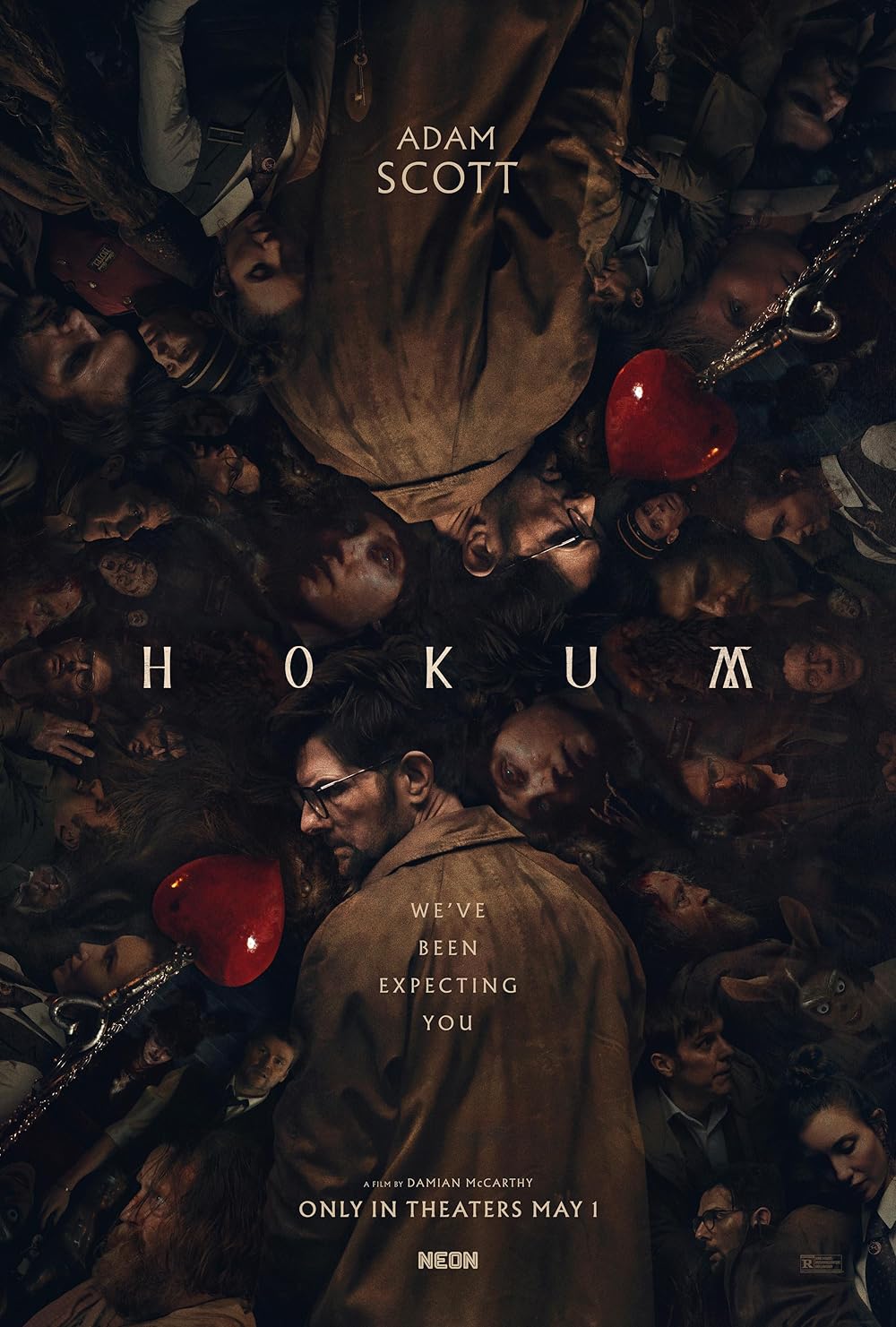
A horror writer visits an Irish inn to scatter his parents’ ashes, unaware the property is said to be haunted by a witch.
Chuck says:
Teeming with atmosphere and driven by a compelling lead performance, Damien McCarthy’s “Hokum” is the kind of film that slowly gets under your skin, a deliberately paced shocker that gradually builds to a well-deserved catharsis for its main character. Shot in Ireland and using its peoples’ folklore as its basis, the director’s intent is not to capture the lush beauty of the country but rather venture into its nooks and crannies where ancient forces lurk its inhabitants would rather not acknowledge. Denial is at the root of many of its characters’ problems, their inability to face their pasts or take responsibility for their indiscretions a seeming invitation for a stark awakening.
It doesn’t take long to tell that Ohm Bauman (Adam Scott) is carrying an awful burden. Abrasive and rude, he suffers no fools, his behavior a defense to keep people at a distance. A successful author of a fantasy series, he’s traveled to the Bilberry Woods Hotel in rural Ireland for a dual purpose. The first is to finish his highly anticipated next novel; the other is to spread his parent ashes. Seems the deceased couple spent their honeymoon there, a particular oak tree being a special spot for them that Bauman finds with little trouble. After completing his task, he stumbles upon Jerry (David Wilmot), a homeless man given to odd pronouncements that are dismissed by the locals but come to have deeper meaning for Bauman.
As one would expect, the hotel has its share of eccentrics. Mal (Peter Coonan), the manager, is always on edge, convinced the owner, his father-in-law, hates him. Fergal (Michael Patric) is a jack-of-all trades who enjoys killing sheep with his crossbow and Alby (Will O’Connell), is a rather clueless porter who juggles a variety of other jobs. Cob (Brendan Conroy), the proprietor has a mean streak he makes no effort to contain, while Fiona (Florence Ordesh), appears the most normal of the bunch but has a secret of her own.
They all play a part in Bauman’s redemption as he’s forced to come to terms with a deed from his past. This is done in the confines of the Honeymoon Suite a supposedly haunted room he makes the mistake of entering. It’s to Scott and McCarthy’s credit that they’re able to sustain our interest during the final hour of the movie. Tempting narrative stagnation, most of the story takes place in this one location, yet McCarthy’s intriguing, layered plot and the actor’s compelling work keep the audience engaged throughout.
Kudos to production designer Til Frohlich and cinematographer Colm Hogan. Their combine efforts produce a genuinely disturbing and oppressive environment throughout, particularly during Bauman’s extended stay in the haunted room. Warm hues that are normally comforting become suffocating while the close nature of the suite’s accoutrements convey the character’s sense of isolation to marvelous effect. This, along with McCarthy’s tight shots make for an effectively claustrophobic environment.
Reflective surfaces play a key role in the film, Bauman encountering them again and again, his need to reflect on his past becoming apparent. His journey towards healing begins with his convincing himself he’s worthy of forgiveness, a notion he’s dismissed as just so much nonsense. All that occurs at the hotel forces him to come to terms with the guilt he carries, a process that can only begin with his acceptance of things he does not understand. “Hokum” proves an effective metaphor for being open to that which is alien to us, a daring act which may lead to a better understanding of ourselves and the world around us.
3 1/2 Stars