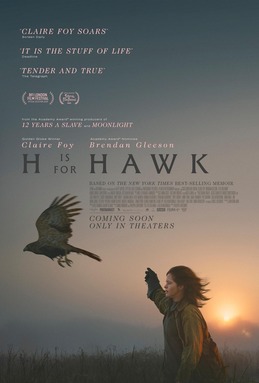
After losing her beloved father, Helen finds herself saved by an unlikely friendship with a stubborn hawk named Mabel.
Chuck says:
Grieving is a very personal experience. Some are very open about it; others wish to do so in private. Still others live in denial and push it aside, only to have it overcome them at the most unexpected of times. As such, unless someone is else is harmed as a result, no judgement should not be passed on those trying to come to terms with the loss of a loved one. Coping with a life-changing events such as this is a solitary journey, one often riddled with setbacks and minute periods of progress.
Philippa Lowthorpe’s adaptation of Helen MacDonald’s memoir “H is for Hawk,” examines the author’s struggles with the loss of her beloved father. The film struggles mightily but ultimately fails to engage the viewer. Appropriately somber in tone, it never allows us access to its heroine’s true intent, a fatal approach that keeps the viewer at arm’s distance. As a result, we’ve never able to connect with her, the character’s ultimate catharsis a singular, rather than vicarious, experience.
Once they reach a certain age, the passing of our parents is always in the back of our minds. Still, MacDonald (Claire Foy), a professor at Cambridge, is stunned when she’s told of the passing of her beloved father, Alisdair (Brendan Gleeson). A respected photojournalist, he was a man with many interests, among them, apparently falconry. I say apparently, as this is mentioned in passing and referenced in one of the many flashbacks we’re privy to which explains their relationship.
I bring up this point because the bulk of the film concerns MacDonald’s decision to adopt and train a Eurasian goshawk. A notoriously difficult bird, it proves to be a trial to bond with the animal, let alone instruct it. The movie is at its best during these moments and could have benefitted from many more. Frankly, the bird, dubbed Mabel, is far more dynamic than MacDonald, its attempts to acclimate to its new surroundings and owner are filled with tension and wonder.
Lowthorpe seems to know this. The opening credits are a wonder, consisting of close-ups of Mabel’s feathers and features, allowing us to take in the complex nature of its physiology. Something we would likely take for granted is rendered so we can appreciate the marvel it is and serves to explain MacDonald’s fascination with these creatures. Equally compelling are the hunting sequences in which we see Mabel in action, her majestic and predatory qualities on full display.
As such, I would have appreciated more information on goshawks and the purpose of falconry, rather than the cursory nuggets we’re given. And as to how seeing a bird of prey repeatedly rip apart rabbits leads to coming to terms with the death of your father, I’m clueless. To each their own. If this were an activity they did often in their past, this should have been explained. If not, a revelatory moment from MacDonald would have been welcome.
Equally problematic is that not only is Mabel more interesting than MacDonald, but so is her father. A passionate, dynamic man of diverse interests, we see some of his photographs at his wake. A witness to history with a keen eye of capturing the magnificent and the mundane, his work suggests a man with many fascinating stories to tell. Frankly, I’d rather have heard them. In the end, “Hawk” fails in not focusing on a compelling protagonist, either avian or human. That it’s incapable of providing us with a complete portrait of MacDonald ultimately prevents it from taking flight.
2 Stars
Pam says:
The simplicity of the title belies the emotional depth of this true story. “H Is for Hawk” stars Claire Foy as Helen, a young university professor whose world is upended by the sudden death of her father, played by Brendan Gleeson. Their relationship was an emotionally intellectual one, grounded in a shared love of learning and a deep fascination with birds. His loss hits Helen with overwhelming force, leaving her unable—or unwilling—to grieve in ways that feel acceptable or even rational to those around her.
Her mum played with deft skill by Lindsay Duncan, struggles to connect with Helen, never quite finding the right words or gestures to bridge the widening emotional gap. Helen succumbs to the urge to purchase a goshawk and names her Mabel. What begins as an attempt at connection soon becomes an obsession, as Helen isolates herself and alienates even her closest friends. There is comfort in her bond with this fierce, “murderous” bird, but it isn’t until Helen is tasked with writing her father’s eulogy that she understands her own grieving process and the importance that nature has to do with it.
As Helen unravels, the film moves fluidly between present-day grief and moments from the past, illuminating the depth of her relationship with her father. These glimpses help us understand both her profound loss and her inability to understand herself. Ultimately, “H Is for Hawk” is not about collapse, but about the grieving process, the power of nature, and finding a path forward through pain.
Visually, the film is stunning, capturing the misty fields of Wales with a quiet, almost reverent beauty. Foy’s performance is particularly understated, yet complexly layered and creating this character as she interacts with this gigantic carnivorous bird, is beyond description as it feels authentic. It is a powerful demonstration of Foy’s range and discipline as an actor.
“H Is for Hawk” is a thoughtful and moving exploration of grief reminding us that there is no single, correct way to mourn. We all approach the process so differently and the film underscores the grounding power of nature and our innate connection to it. For viewers willing to engage with its quiet intensity, this film offers a deeply rewarding experience. Exploring the background and making of the film only enhances its impact.
3 1/2 stars