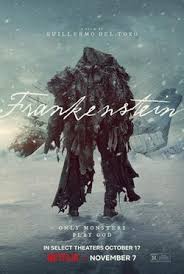
A brilliant but egotistical scientist brings a creature to life in a monstrous experiment that ultimately leads to the undoing of both the creator and his tragic creation.
Chuck says:
Referred to as “my Everest,” director Guillermo del Toro has longed to put his distinctive stamp on Mary Shelley’s “Frankenstein.” Stating recently that each movie he’s made has been in preparation for this undertaking, he was able to secure a $120 million budget and a generous 6 month shooting schedule from Netflix to realize his vision. The result is what you would expect from the filmmaker and well worth the wait. Visually sumptuous, narratively dense and audaciously rendered, this take on the classic existential tale is unlike any other version of the story you’ve seen before. Most importantly, Del Toro brings a sense of humanity to the tale, it ending not in violence but an incident of reconciliation that forcefully drives home Shelley’s theme.
Stumbling out of the gate with a needless, overwrought action sequence, Del Toro begins his version as Shelley did hers, in the frozen north. Leading an expedition to find a quicker trade route, Captain Anderson’s (Lars Mikkelsen) ship has become frozen in the ice, his frightened and impatient crew imploring him to turn back. However, their concerns are put on the back burner when they see an explosion in the distance, and upon investigating find Victor Frankenstein (a wonderfully calculating Oscar Isaac) injured and near death. While taking them back to the ship, they are attacked by an incredibly strong, misshapen creature (Jacob Elordi) intent on killing the injured man.
Once Frankenstein is ensconced in Anderson’s cabin, he relates his story. While the familiar narrative is present, that of the mad doctor and his misguided creation, Del Toro introduces a great many narrative wrinkles and permutations that make for a richer, more dynamic story. The filmmaker provides the titular character with a richer history, positing that his adored mother (Mia Goth) died while he was just a child, leaving him to be raised by his demanding father, Leopold (Charles Dance). A surgeon, he goes to extreme measures while training Victor to follow in his footsteps. The pupil eventually surpasses the master, intent on besting his father, by conquering death.
His wild theories concerning reanimating dead bodies leads to Frankenstein being ostracized from the medical community, but he finds a sponsor in Harlander (Christoph Waltz), another rich Del Toro addition. Having made his fortune in munitions, he funds the doctor’s experiments, setting him in an abandoned water tower in which to work. He does so tirelessly, that is until his younger brother, William (Felix Kammerer) visits with his future bride, Elizabeth (Goth) in tow. She proves to be a distraction he could do without.
All this occurs during the first hour, Del Toro taking his time to establish the world of material and moral decadence that facilitates Frankenstein’s work. Eschewing computer-generated effects, production designer Tamara Deverell renders a sumptuous gothic environment that wallows both in the trappings of the 19th century aristocracy and the charnel house the titular character’s lab becomes. This is the sort of film coffee table books are made for, the meticulous nature of every set something to be studied, the minute details providing an immersive experience that creates a sense of place pixels could never hope to accomplish.
Equally overwhelming are sequences focused on the construction of the creature. Working with bodies harvested from the battlefields of an ongoing war, we see Frankenstein dissect these cadavers, snap bones from one body into the sockets of another and stitch his work together. Though graphic, these scenes never come off as gratuitous but rather moments of clinical practice, necessary to underscore the doctor’s determination as well as his madness. Together, these moments create a portrait of an artist at work.
Once the creature makes his first appearance, the relationship between creator and creation is fully explored. Initially astounded, Frankenstein dotes on his “son,” before becoming disillusioned, suffering a sort of post-partum depression, when his progeny fails to live up to his expectations. Yet, upon discovering him, Elizabeth gives the creature the nurturing he needs, providing the film with its most touching moments. In these scenes, and throughout, Elordi is a marvel, his character is far from monstrous but seen as an awkward child. Struggling to understand the world he finds himself in, his eyes convey a sense of innocence that will be torn asunder when Frankenstein attempts to destroy him, setting his laboratory ablaze.
The second part of the film concerns the Creature’s efforts to survive, his grotesque appearance dooming him to be a pariah despite his innocent nature. As in the novel, he stumbles upon a home where a blind man lives with his family, observing that peace can be found with a loving family, learning to speak and write with some conveniently discarded books. Yet, once discovered he’s driven away, leading him to return to Frankenstein and request he make him a companion, leading to tragic results.
Though running nearly two and half hours, there’s a sense of urgency in the film, ensuring it never lags. This is a well-oiled machine, hitting on all cylinders, Deverell’s astounding sets, the cast’s passionate performances, Alexandre Desplat’s rousing score, Dan Lausten’s atmospheric cinematography and Del Toro’s writing and directing, all working in harmony to create a distinct, at times overwhelming, but ultimately moving film experience.
Purists may quibble at the liberties Del Toro takes with Shelley’s text. Cribbing elements from James Whale’s original and as well as “The Bride of Frankenstein,” the Hammer Horror cycle, the art of Bernie Wrightson, Greek mythology and other sources, this could have come off as an unwieldy pastiche. However, there’s a reverence in Del Toro’s approach, these parts melding perfectly with the filmmaker’s exploration of the original text’s characters and themes. The result is an ambitious, astounding, singular piece of work that requires many viewings to unpack all it contains. Unlike his film’s protagonist, Del Toro’s amalgam is no monstrosity but a masterpiece.
4 Stars