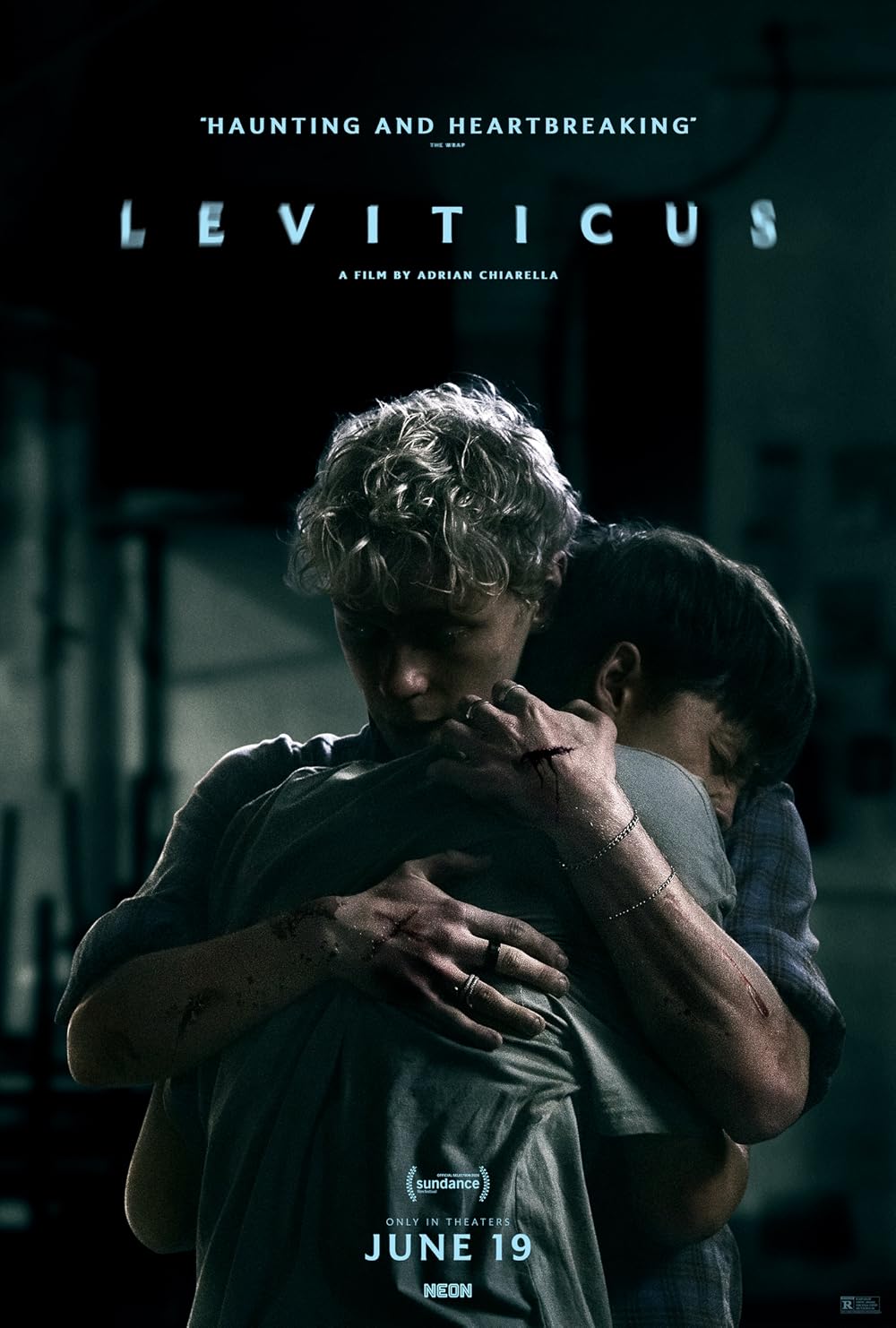
Two teenage boys must escape a violent entity that takes the form of the person they desire most – each other.
Chuck says:
Though discredited, conversion therapy relating to homosexuality is still being used today, albeit with much less frequency. Some of these practices are folded into other approaches,have been renamed and also presented as a free speech issue through a U.S. Supreme Court ruling issued in early 2026. While steps are being taken to eradicate or render it illegal, the long shadow of this approach is still present, shouldered by those who’ve had to endure it.
Adrian Chiarella’s wildly ambitious, densely packed “Leviticus” looks at not simply the lingering effects of conversion therapy but its impact on those close to those who’ve been subjected to it. Running a taut 82 minutes, this low-budget affair succeeds thanks to the filmmaker’s clever horror conceit. Love and trust are the lure the entity at the center of the film uses to render his victims vulnerable to attack, ultimately leaving them emotionally shattered, unable to trust their own instincts and feelings.
Naim (Joe Bird) is a young man, whose life has been upended in multiple ways. His father has died recently and he and his mother (Mia Wasikowska) have moved to the industrial community of Victoria, Australia, to start over. And while she has found solace in the fundamentalist church she’s joined, her son continues to flounder. He gets a lifeline from Ryan (Stacy Clausen), a handsome, dynamic classmate who’s obviously attracted to him. They have tentative interactions that lead to intimacy and soon fall in love.
However, that doesn’t stop Ryan from experimenting with others and when he’s caught in a compromising position with the pastor’s son (Jeremy Belwitt), they’re brought before the congregation. Publicly shamed, the two boys are forced to witness a ritual that will drive away their “impure thoughts.” Neither taking it seriously, this pair, nor Naim who is also affected, are prepared for the supernatural ramifications that result.
Chiarella wisely doesn’t initially explain the source of the violence that’s visited on these three, allowing the viewer to vicariously experience their own fear and confusion. Eventually, it becomes clear that Naim is being attacked by a creature that looks like but is not Ryan, that wishes to kill him. Ryan’s assailant has the same intent and looks like Naim but to complicate things further, no one but them can see these entities.
The attacks are sudden and shocking, Chiarella cutting off our field of vision with tight shots, creating a kind of tunnel vision. This proves to be an effective tool to convey the exclusivity of vision love can create, the euphoria present at the beginning of a relationship when you are consumed by the object of your affection at the expense of everything else. The lethality of this situation is driven home again and again, both Naim and Ryan falling victim to a creature who has the appearance of their respective lover, the result leaving both of them emotionally and physically wounded.
The parallels to the inherent pitfalls of emotional intimacy are obvious but no less effective. The seeming duplicity of a loved one – that person who’s vowed to love you forever but then suddenly breaks your heart – has rarely been presented with the kind of devastating power as it is here. As a result of these creatures’ actions, Naim and Ryan come to distrust one another, driving the doubt that results when a partner proves duplicitous.
But more than that is the way this premise hones in on the vagaries of conversion therapy. Denying a key part of yourself is the goal of this procedure, a result of the ritual Naim and Ryan endure and is reflected in the boys’ respective assailants. They come to doubt their own judgement, can no longer trust the person they’re devoted to and are forced to wrestle with the shame and confusion that results.
Bird and Clausen are both fantastic, each giving impassioned turns, both conveying the sense of confusion and hurt their characters are feeling in a way that’s palpable. The early scenes in which the actors capture the feelings of elation and security present in the first phases of a love affair prove haunting, when confronted with the emotionally battered and confused young men in the film’s final shot.
As dire as the film’s theme is, in the end Chiarella provides his two protagonists with a small degree of hope, suggesting they can find a fresh start in a new environment. Yet, “Leviticus’” final message is they will never escape what they’ve experienced. Whether Naim and Ryan will ever be able to heal from the damage done to their psyches is in question. Chiarella’s film is a gift to anyone questioning their self-worth, reminding them that in their struggle, they are not alone.
3 1/2 Stars