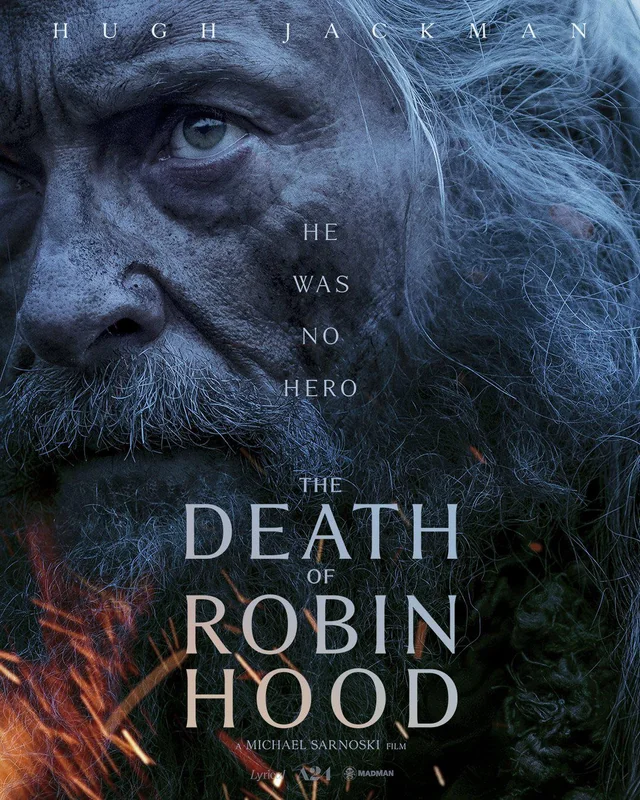
Grappling with his past after a life of crime and murder, Robin Hood finds himself gravely injured after a battle he thought would be his last. In the hands of a mysterious woman, he is offered a chance at salvation.
Chuck says:
Michael Sarnoski’s “The Death of Robin Hood” is the sort of film you admire rather than enjoy. Nearly collapsing under the weight of its intentions, this revisionist take on the seminal figure in English folklore is a dour exercise, both visually and thematically, hobbled by its deliberate pacing. Yet, Sarnoski’s immersive mise en scene and strong performances from his solid cast keep the viewer somewhat engaged, though the movie threatens to stall at any given moment.
Taking cues from Henry King’s “The Gunfighter” and Clint Eastwood’s “Unforgiven,” Sarnoski’s Robin Hood (Hugh Jackman) is a man who cannot outlive his past, a figure whose reputation dwarfs and distorts the truth regarding his history. Far from a benevolent vigilante, this is a man of violence, a figure who, in his youth, prompted fear in those he crossed rather than admiration. Longing to be left alone, his cohort Little John (Bill Skarsgard) convinces him to help him rescue his wife, Margaret (Katie Breen) and daughter, Little Margaret (Faith Delaney), who are being held by a group of marauders.
It all goes badly and as a result Robin is taken to a nearby island, home to a group of disparate refugees, overseen by Sister Brigid (Jodie Comer). She helps mend his wounds, despite his pleas to be allowed to die. While getting back on his feet, Robin befriends a leper (Murray Bartlett), takes Little Margaret under his wing, and becomes a bulwark for all the outcasts on the island. This he does reluctantly but is surprised by the sense of peace he begins to feel. However, all of this is threatened by the arrival of Arthur (Noah Jupe), a young man who may reveal Robin’s past to his new companions.
The very definition of a slow burn, “Death’s” intention to present a meditative examination of Robin’s path to redemption is narratively sound. Yet its execution is flawed as Sarnoski takes far too much time moving the story to that point. Though every scene is necessary in showing Robin’s transformation from killer to protector, they all run far too long, robbing the story of a sense of urgency.
The graphic violence and gritty, grim aesthetic of the first act effectively establishes the harsh 13th-century environment, a dank, dirty world suffused more with death than life. The action scenes early on are brutal, some to the point of being gratuitous. So, while the later bucolic setting of the island is welcome, the action from that point on becomes internal, as Robin quietly tries to reckon with his past. This tonal duality is necessary, yet it proves a chore to sit through.
Jackman, channeling his Wolverine character from “Logan,” not only brings the gravitas necessary for the character but conveys his sorrow with a subtle poignancy. A simmering sense of regret informs all the actor does. Comer counters this, acting as a ray of light in this dismal world. The actresses’ calm, yet strong demeanor effectively balances her co-star’s approach and it’s too her credit that Brigid comes off as no one to be trifled with and every bit Robin’s equal. However, a third-act revelation regarding a past connection between the two comes off as a bit too convenient and, in the end, unnecessary.
Noble in intent, “Death” is a bit of a slog, a movie you wind up enduring rather than engaging with. Though its theme of redemption is hardly new, credit must be given to Sarnoski’s conviction to it. Too bad its ultimate impact is dulled due to the overtly deliberate and solemn manner in which he delivers it.
2 1/2 Stars