A widow plans her husband’s funeral. Her estranged son sends his assistant instead of coming himself. The Widow grieves with the assistant.
Chuck says:
Theres sure is a lotta speechifying in Jim Rash’s “Miss You, Love You.” Far too often, its angry, forlorn characters set their feet and rattle off a litany of complaints and hurt that sounds as if it been rehearsed numerous times internally before spewing forth. Of course, there’s nothing wrong with a showstopping moment here or there, but it gets to the point here that as soon as I saw two characters standing opposite one another and a close-up of one occurred, I knew a diatribe was in the offing.
This certainly isn’t the only thing wrong with this well-intentioned film, but it’s the most glaring. Essentially a two-hander, the movie’s premise is solid enough, yet its theatrical nature, both in its staging and execution, makes it come off as more of an exercise than an intimate portrait of two souls in pain, each grappling for understanding and relief.
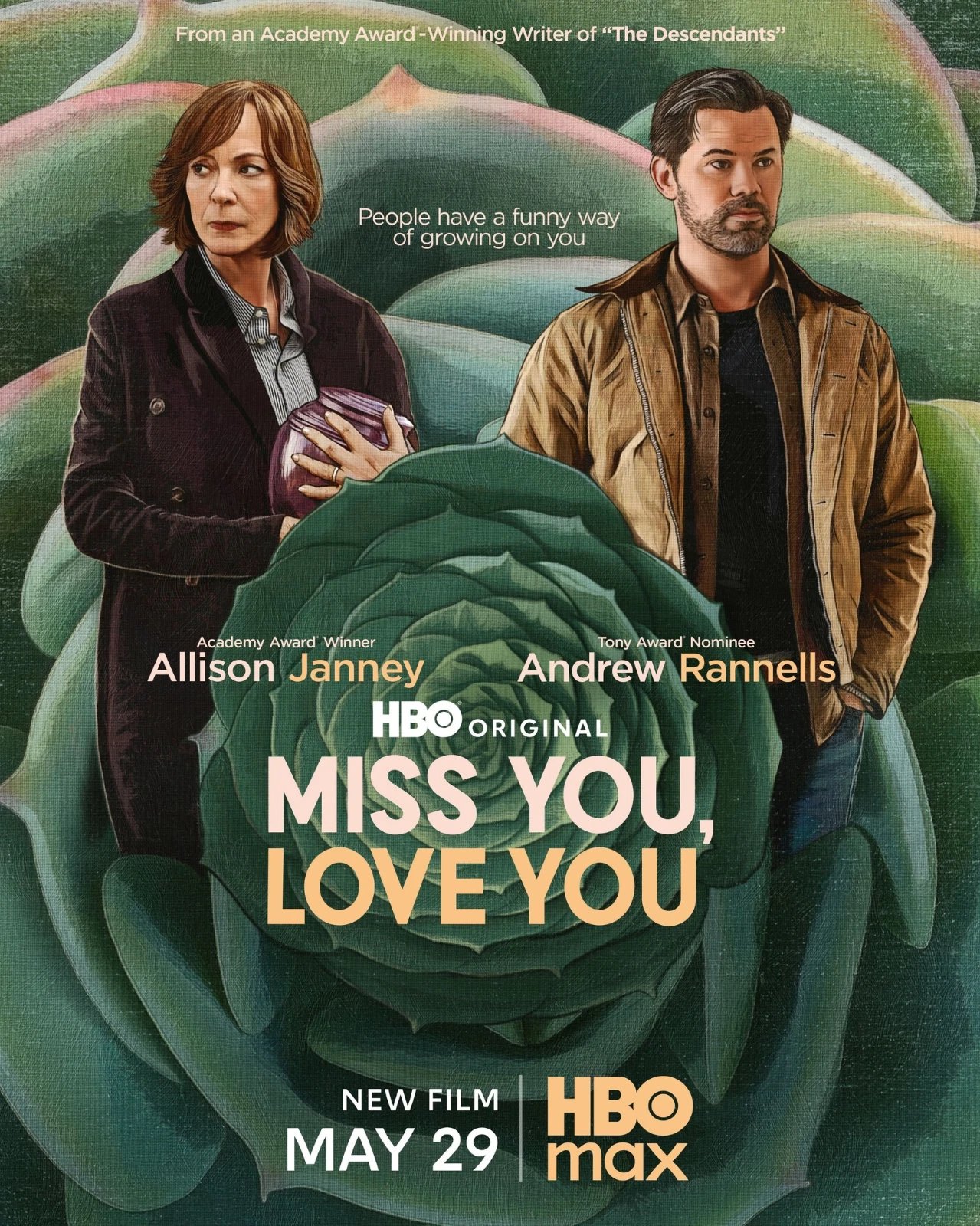
Embracing her anger rather than letting it consume her, Diane (Allison Janney) is a force to be reckoned with. Preparing for her second husband’s funeral, she’s beside herself when her son informs her that due to work commitments, he will not be able to come help her through this difficult time. Instead, he sends his assistant Jamie (Andrew Rannells). Pity this poor guy as he has no idea what he’s walking into. Diane is a buzzsaw of fury, laying into him repeatedly, verbally flaying him again and again in the place of her absent son.
Over the course of a week, confessions are made, lies are told, drama ensues and a degree of respect is built between the two. In processing her grief, Diane tells of her resentment over relocating from New York City to New Mexico for her husband’s sake, the pain of her witnessing his slow decline due to Parkinson’s and the reason for her son’s estrangement. In turn, Jamie shares his own regrets regarding his absent parents, his career choices and his own dealings with Diane’s son, revealing a common thread that brings these two together.
Were it not for the work of the two leads, the film would have been insufferable. Janney’s performance is one comprising of variations on a single note but in her defense, Rash’s script has Dianne do nothing but rage and rage some more. Rannells is allowed a far greater variety of emotions to tap into, Jamie required to be polite, flummoxed, defensive and finally, vulnerable in varying degrees throughout. The actor steals one scene after another, knowing to step back as his co-star rends the scenery, his calm demeanor drawing us in like a port in a storm.
Still, despite the fine work from these two, there’s just something a bit too calculated in Rash’s construction. The repeated, loud airing of grievances or extraction of confessions become predictable and tedious, while attempts at humor, provided by an underused Bonnie Hunt as Diane’s clueless neighbor fall flat. Though the film runs only 97 minutes, it feels much longer.
To be sure, the relationship dynamics Rash brings to the table are timely and worthy of further discussion. The distance that exists between Diane and her son, exacerbated by his hollow texts to her that always end with “Miss You, Love You,” is not unique in both physical and emotional terms. Bridging these gaps requires a degree of sincerity that can overcome the difficulties that exist between loved ones. Had “Miss” employed a few more quiet, genuine moments, than repeated histrionics, it may have fostered the sort of emotional honesty its director was striving for.
2 Stars