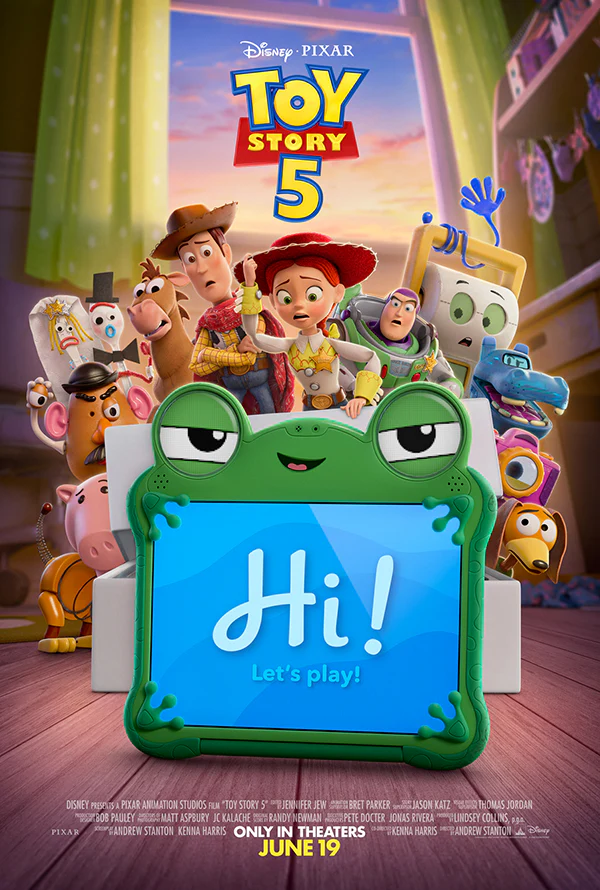
Woody, Buzz, Jessie and the rest of the gang’s jobs are challenged when they’re introduced to electronics, a new threat to playtime.
Chuck says:
I doubt that way back in 1995 (yes, it’s been 31 years) when John Lassiter, Pete Docter and Andrew Stanton released “Toy Story” that they knew they were embarking on creating a franchise that’s become a touchstone for so many people. Like the great Pixar films, the themes in the movie were aimed just at much at adults as it was kids, likely more so. That these films continue to remind us of the precious nature of childhood, the value of imagination and the importance of play, all conveyed by toys with a universal appeal, is quite remarkable.
The fifth entry in the series makes a conscious effort to speak to a new generation of kids as well as their parents, who were likely not yet teens in 1995. To be sure, the novelty of talking toys with an interior world of their own has worn off a bit, there’s still enough juice in the tank to make this sequel worthwhile. The gentle humor, the occasional double entendre and the endearing nature of the characters are still present, all in the service of delivering a vital, timely message.
Having found a home with Bonnie, the toys have settled into a routine. With Woody (voice by Tom Hanks) absent, having run off to find happiness with Bo Peep (Annie Potts), Jessie (Joan Cusack) has become the de facto leader of the group. As for Buzz (Tim Allen), he’s still around but he’s knocked back on his heels when he realizes he’s fallen in love with Jessie. He spends a good deal of time trying to come up with a romantic way to propose.
If the toys have one concern, it’s that Bonnie doesn’t seem to have any friends. One thing that keeps her on the outside is that she plays with old-fashioned toys, not electronic gizmos. Her parents rectify that by getting her a Lilypad (Greta Lee), a tablet geared towards helping her learn. They tell themselves they’ll limit her screen time. We all know how that turns out…
As Bonnie becomes more and more engrossed with her pad, the toys begin to suffer a collective existential crisis. This hits Jessie particularly hard, her memories of being abandoned by previous owners still painful. This is exacerbated when she ventures out and meets a pseudo-support group for abandoned toys who inform her “the age of toys is over.” Circumstances bring her back to the home of her original owner, an event that dredges up unwanted memories.
The continued appeal of the Pixar films has been their ability to channel genuine, real-world emotion into this artificial arena of play. Jessie’s angst over being forgotten and becoming irrelevant cuts deep, the faded names of her previous owners written upon her serving as scars. More than that, she’s contending with a fear of commitment, lamenting that, “I can’t love another kid just to find out I didn’t matter.” That we relate to her fears is a tribute to Pixar’s genius.
As with each new entry, a fresh group of toys are introduced, the most memorable being a trio Jessie meets at her old home. Atlas (Craig Robinson) is a toy hippo with a GPS who’s eager to give directions, while Snappy (Shelby Rabara) is a camera willing to take a picture of anything. However, the stand out is Smarty Pants (Conan O’Brien), a potty training device in the shape a toilet roll and holder. His snarky comments and mild scatological humor are one of the film’s strongest assets. (See what I did there…)
While this is ostensibly Jessie’s story, Pixar knows what side their bread is buttered on and makes sure Woody returns to lend a hand in what’s become a predictable conclusion to these films. Yet, along the way writers McKenna Harris and Stanton come to terms with the movie’s central question in a wise, logical manner. In the end, “Toy Story 5” reminds us that whether you’re a six-year-old girl, a rag doll, an electronic gizmo or even a toy shaped like a roll of toilet paper, acceptance and validation are paramount to our well-being. And of course, having a healthy imagination.
3 Stars