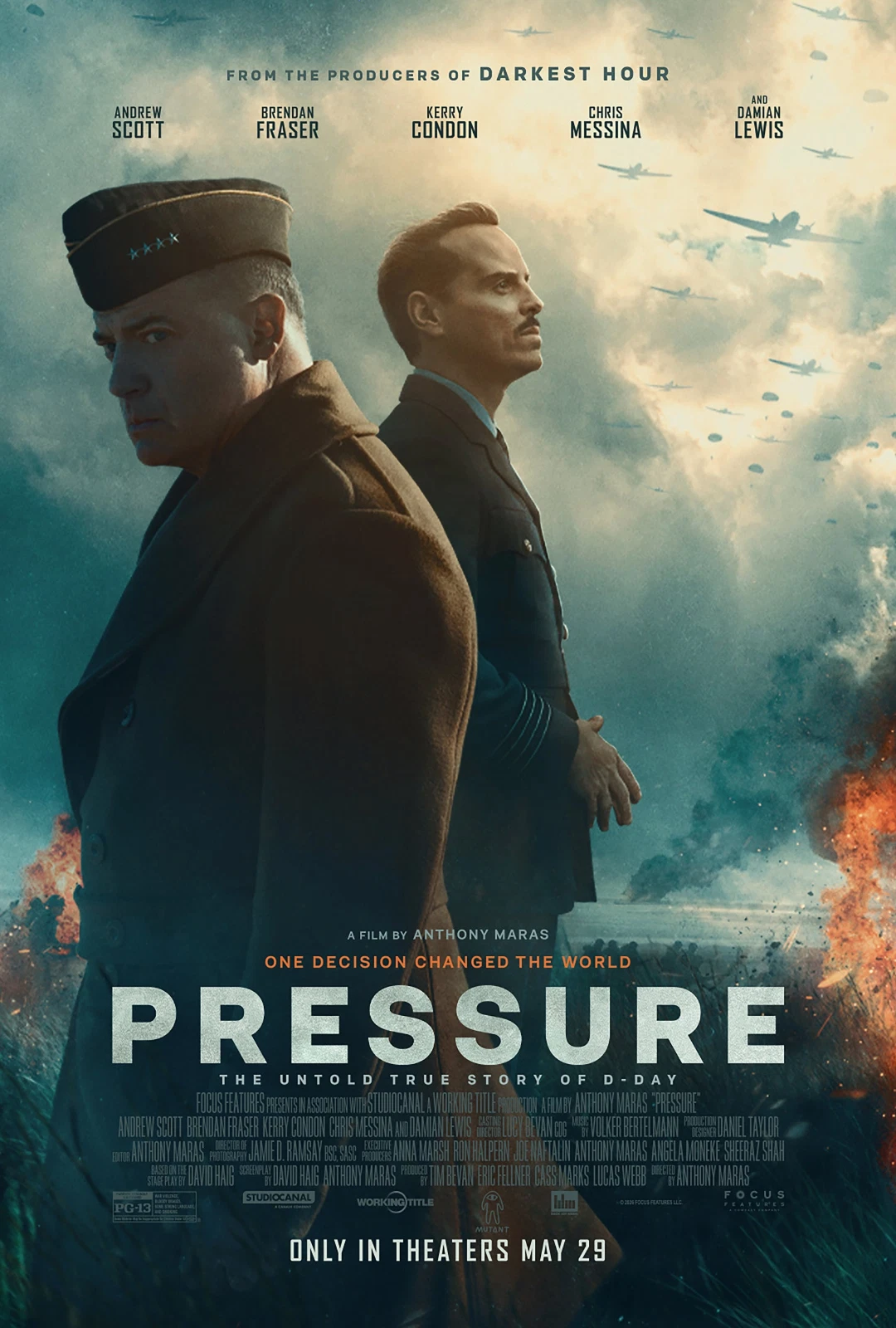
In the tense 72 hours before D-Day, General Dwight D. Eisenhower and Captain James Stagg face an impossible choice–launch the most dangerous seaborne invasion in history or risk losing the war altogether.
Chuck says:
It’s hard to grasp the scope and planning that went into the D-Day invasions that occurred on June 6, 1944. Preparations began in mid-1943 that would result in the deployment of over 156,000 Allied Forces soldiers over a 50-mile stretch of beach across two time zones. Seven million tons of supplies were utilized, including 450,000 tons of ammunition. 17 million maps were produced. A variety of nearly 7,000 sea vessels were used, in addition to 2,395 aircraft and 867 gliders, with over 3,200 tons of bombs dropped further inland. At the end of five days, 326,547 Allied troops had landed, along with 54,186 vehicles and 104,428 tons of supplies.
And all of this hinged on the accuracy of a weather report.
Anthony Maras’ “Pressure” takes a deep dive into this oft-overlooked aspect of this historic event. Unexpectedly fascinating, this examination of the behind-the-scenes drama that went into making a prediction upon which thousands of lives depended, is gripping from start to finish. Clocking in at 100 minutes, this is a refreshingly brisk exercise that gives an overlooked hero the credit he’s been long denied, a man who withstood a barrage of resistance and pressure no one should have to endure.
Britain’s leading meteorologist James Stagg’s (Andrew Scott), new assignment comes at the worst possible time. What with his wife, Liz (Tamsin Topolski) about to give birth, the last thing he wants is to leave home. Yet, duty calls. Acting on a recommendation from Winston Churchill himself, General Dwight D. Eisenhower (Brendan Fraser) has requested he help his own team of weather experts come up with an accurate forecast for the upcoming D-Day Invasion on June 5th.
Preoccupied with his life and sporting a fastidious, unbending demeanor, he meets resistance from the start. The American weathermen, led by Irving Krik (Chris Messina), and their lack of decorum rankles him, while their reliance on making predictions based on past patterns strikes him as lazy and unreliable. His insistence that he knows the weather of his homeland better than they falls on deaf ears as does his warning that it is also highly unpredictable. The conflicting reports and contentiousness between Stagg and his own staff, doesn’t sit well with Eisenhower, who’s depending on a consensus among them where their predictions are concerned.
Maras and his co-writer David Haig, whose play the film is based on, manage to make conversations about jet streams and high-pressure systems not only seem vital but fascinating. Without dumbing things down for the viewer, scenes focused on these subjects combine dialogue with images of rapidly forming or dissipating storms, all of which heightens the tension. Intercutting images of rows of dead, bloodied Allied troops washed up on the beach after a practice exercise, does so as well.
The work of the fine cast compliments their efforts beautifully. Fraser is convincingly gruff as Eisenhower, yet he’s also able to convey the general’s inner conflict and doubts. These quieter moments are where the Oscar-winner shines, as he brings a vulnerability to the man that proves poignant. The always reliable Kerry Condon is also on board as Eisenhower’s assistant Kay Summersby, the actress’ combination of flinty directness and quiet compassion a perfect fit for the character. During their moments together, these screen vets convey as much when they are silent as when speaking.
Of course, the success of the entire film depends on Scott and he’s more than up to the task. The actor brings a coiled demeanor to the character that becomes harder and harder to maintain as the clock ticks. As his face gradually tightens, his attire becomes unkempt and his voice becomes a rattling rasp, the actor creates a portrait of frayed grace under pressure, a man determined to face resistance at every turn for what he knows is right. Scott puts himself through the wringer and we can’t help but rejoice with Stagg once his inner storms pass because of it.
In the end, “Pressure” serves as tribute to the men and women who stood strong in the face of the greatest threat to democracy the world has ever faced. The film’s power comes from not portraying them as simply steely, determined individuals who put on a brave face but rather as people wracked with doubt and fear. In overcoming these thoughts and emotions, they serve as stirring examples of selfless, unwavering determination, men and women with a degree of character that’s become too rare. “Pressure’s” greatest gift is providing their stories so we may look to them once more for inspiration in combating current threats.
3 1/2 Stars