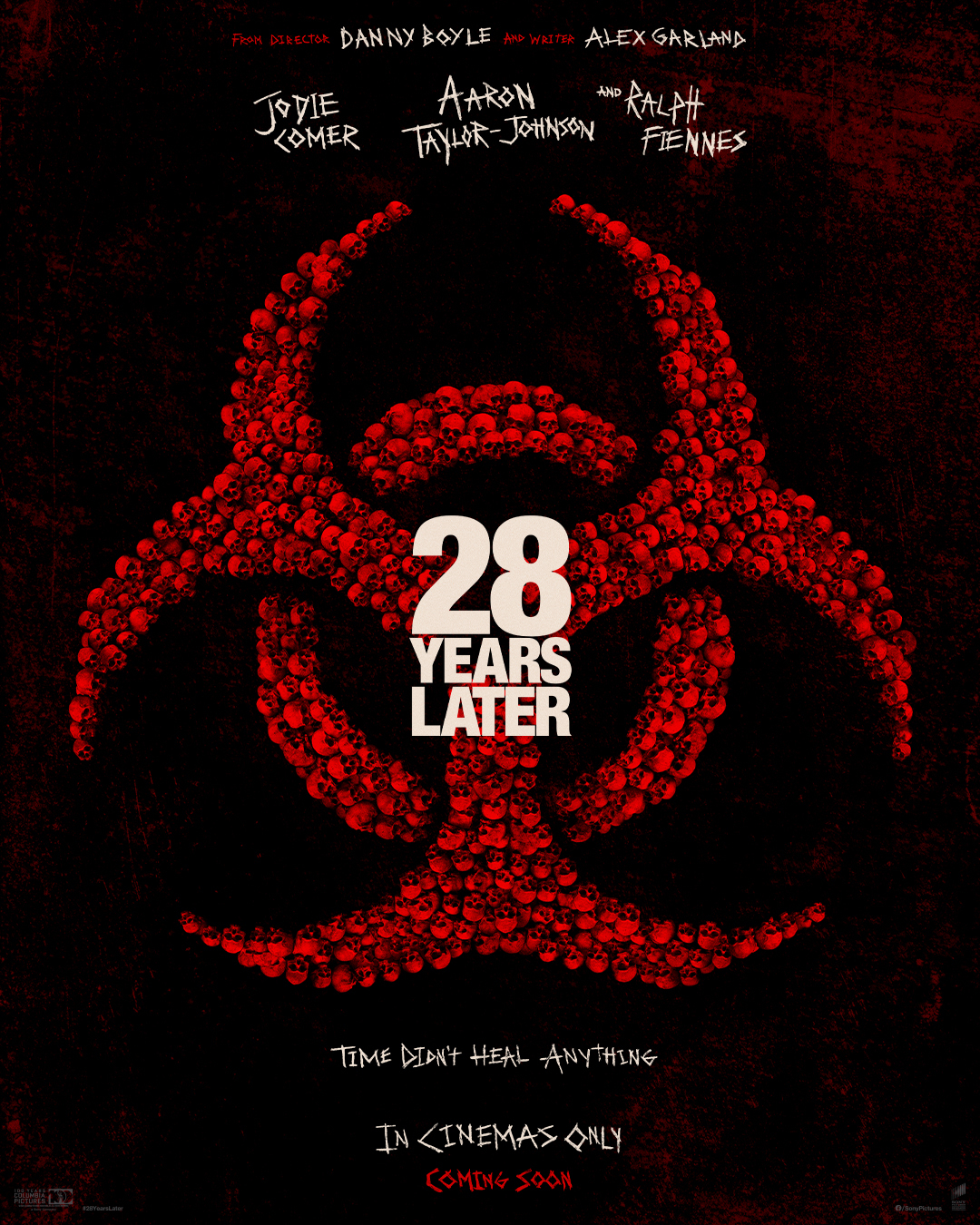
A group of survivors of the rage virus live on a small island. When one of the group leaves the island on a mission into the mainland, he discovers secrets, wonders, and horrors that have mutated not only the infected but other survivors.
Chuck says:
At times terrifying, at others tedious and finally, moving, Danny Boyle’s “28 Years Later” is nothing short of ambitious as the director returns to the franchise he birthed some 23 years ago. While there are social and political concerns at the film’s core, at times it seems his intent is do nothing more than make us soil ourselves. Having been saturated with zombie violence over the last two decades, Boyle knows he needs to amp things up in order to get a rise out of viewers and he achieves this with a visceral approach that’s shocking and off-putting. That he emphasizes the humanity of those being dispatched makes it all the more horrifying.
After a shocking prologue that manages to make the Teletubbies more disturbing than they already are, the action shifts to a small island off the British coast. 12-year-old Spike (Alfie Williams) is about to go through a rite-of-passage, his mother Isla (Jodie Comer) vehemently opposes. He’s to accompany his father, Jamie (Aaron Taylor-Johnson), to the mainland via a causeway that makes the trip possible during low tide. These excursions, made in the hope of finding food and supplies, are fraught with peril, as those infected with the Rage Virus are still about, eager to consume anyone that crosses their path. Still, Jamie is confident in his son’s skills with a bow and arrow and feels this is a vital step in his development.
Of course, things go sideways, yet the father and son manage to return, but not before Spike sees a fire in the far-off forest. His father informs him it’s coming from the home of Dr. Kelson (Ralph Fiennes), a physician he says has gone mad. What with his bed-ridden mother acting strangely of late, he suggests they take her to see him. And though Jamie says it’s too dangerous, Spike ultimately takes matters into his own hands, sneaking away with Isla to the mainland in the hopes of getting her help.
This is a flimsy premise at best, and the film’s pacing slows dramatically during this quest. While the moments between Williams and Comer are effective, their scenes proceed lugubriously, taxing our patience. Contributing to the ever-encroaching tedium are needless action scenes with a trio of – and then only one – soldiers who attempt to help the mother and son. These moments of carnage add nothing to the already blood-soaked story.
However, once they reach Kelson, the film rights itself, emphasizing the theme of maintaining hope in hopeless times to genuinely poignant effect. His philosophy regarding death proves to be a balm for Spike and Ilsa. His perspective transcends the movie, a reward for the viewer, having endured the brutality Boyle’s created.
The director employs rapid editing, a destabilized camera and varying visual speeds to create an unnerving experience. Shooting at eye level, he puts us in Spike and Jamie’s shoes, creating a sense of panic as we see from their point of view the quickly moving threat closing in on us. The effectiveness of this approach never wanes, the terror of the situation palpable throughout.
A sequel, “The Bone Temple,” has already been shot, Spike left in a potentially dire situation that promises further commentary on societal norms, nationalism and demagoguery. With Boyle’s outlook on the world so sobering, it makes the glimmer of hope he and screenwriter Alex Garland provide all the more meaningful. Like the best horror films, “Years” serves as a bracing metaphor for our times. I just wish it had gotten to its point, a bit quicker.
3 Stars