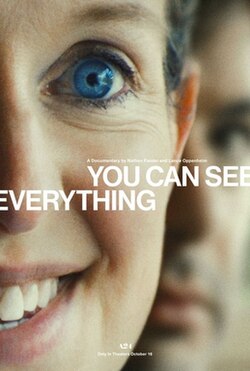
Thirty-four days before she’s sent to prison, notorious Theranos founder Elizabeth Holmes invites a skeptical film crew to document her every move. What begins as an intimate portrait becomes a mind-bending three-year journey.
Chuck says:
“Remember, as a documentarian you are an observer, an author but not a director, a discoverer, not a controller.” – Albert Maysles.
I suppose that’s one way of looking at what the role of a documentary filmmaker is. Maysles and his brother, David have adhered to this philosophy with great success, having made genre classics such as “Salesman” (1969), “Gimme Shelter” (1970), and “Grey Gardens” (1975), as well as many others, capturing events and presenting them as they witnessed them. But of course, that doesn’t necessarily mean, they’re telling us the truth.
The role of the documentary filmmaker, and just how honest this format is, has been called into question since the first feature-length example, “Nanook of the North” hit screens in 1922. Though its director Robert J. Flaherty insisted all that was on the screen was true, further investigation revealed he had his titular subject stage many of the filmed sequences. The director’s reasoning was he was only reenacting things he knew did happen in a more dramatic way. This was just enough to cast doubt on the format and thus was the beginning of the genre being looked at with a skeptical eye.
The narrative of such films can be shaped as much by what the filmmaker leaves out as much as what is included, while the question of perspective is always called into doubt, especially where subjects regarding politics or society are concerned. Michael Moore has made a career out of taking an unapologetic stance in his films, using his version of the “truth” to champion a variety of causes.
Director Nathan Fielder’s intent with his film “You Can See Everything” is to muddy the waters between what is fact and fiction, even further. With the exceptions of “The Odyssey” and “Digger,” there’s no other movie this year that’s generated as much hype or polemic discourse. Initial interest was stoked when it became known Elizabeth Holmes, the disgraced and convicted corporate head of Theranos Corporation, would be Fielder’s subject. However, since its release, much of the conversation has focused on the filmmaker’s obvious manipulation of the material he’d captured.
To be fair, Fielder hides nothing where his process is concerned. We see him enter the Holmes’ household, where he lived with her, her partner Billy Evans and their two small children during the 34 days leading up to the beginning of her prison term. The first half of the movie plays like a straight doc, as we see the couple go about their daily lives, all the while trying to resurrect their careers and reshape the public’s perception of Holmes.
However, once the 34 days pass, Fielder completely abandons the constraints of the genre and the film becomes something else altogether. More a reality-based entertainment, “See” morphs into a mind-bending game of manipulation that plays out not only on the screen but between the director and the audience as well.
Granted, the relationship between the filmmaker and viewer has always been based on manipulation, whether it be a work of fact or fiction. Yet, what Fielder does here is shatter that tacet agreement, openly toying with our perceptions of what we have seen and what we have not. He should be given credit for being so open about his intent and process. If he should receive praise for his machinations and the way in which he treats his subjects is open to question.
As we watch “See” unfold, the viewer finds themselves in the company of three master manipulators, each with their own agenda, which they are prepared to move forward at any cost. Fielder’s focus is the movie, Holmes is to clear her name and Evans…well, the less said the better.
I’ve rarely heard so much talk that amounts to nothing. Half-truths, vague facts and grand promises are bandied about by Holmes and Evans as they try to resurrect Theranos under a different name. As they wheel and deal online and via telephone, it’s easy to see how so many were initially duped by Holmes. Fielder is no less guilty, as his line of questioning towards Holmes is at times purposely vague, as if he is setting out to confuse her. That he does not phrase things more simply seems a calculated ploy to make her look foolish. As for the conversations between Fielder and Evans, all they say is calculated and guarded, neither of them wanting to divulge their intentions. None of it and no one is to be taken at face value at any point.
Regarding Holmes, surprisingly she comes off as the most sympathetic of the lot. Keep in mind, that standard is low as set by this trio. By no means does Fielder imply she’s innocent of the fraud charges leveled against her, but there’s something amiss regarding how she sees herself and her situation. If nothing else, you’ll likely come away with the notion that she’s firmly convinced she’s telling the truth. Her utter conviction in this is what makes her so beguiling and dangerous.
Its obvious Fielder is captivated by her, mystified by Evans and blinded by hubris. The film runs far too long, the director repeatedly beating a dead horse long after making his point. If nothing else, he has created an intriguing, curious three-pronged character study, while the film’s title is revealed to be purposely misleading. While “See” clarifies some things regarding Holmes, much remains in question. The only absolute truth that emerges is none of the three principals are to be trusted. That Fielder ends up indicting himself in casting himself in the same light as his subjects is a delicious bit of irony.
3 Stars