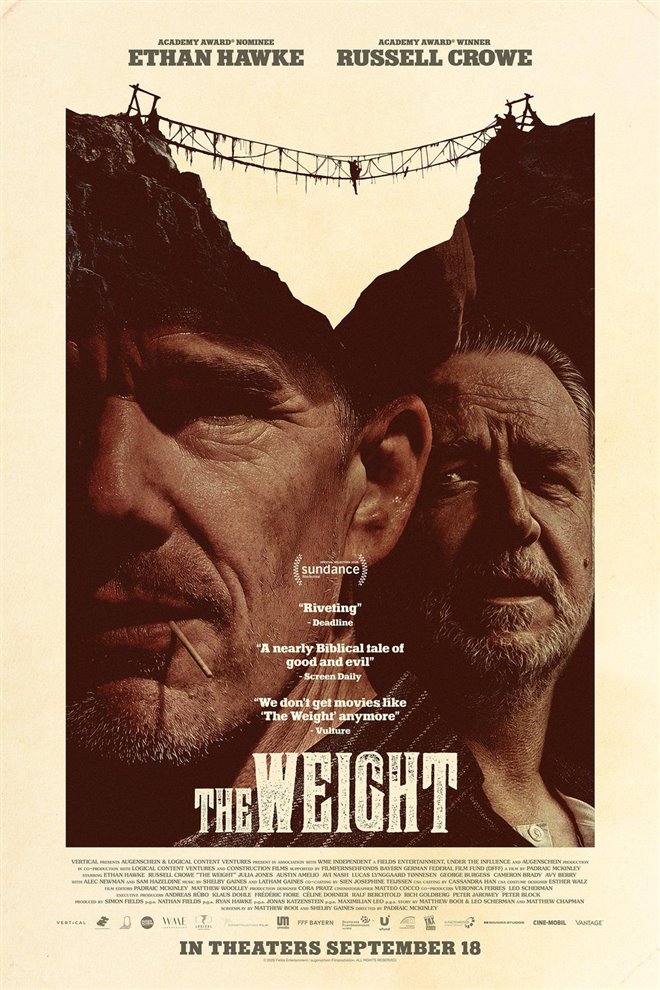
Desperate to save what is left of his family, during the height of the Great Depression a battle-scarred veteran is hired to help smuggle a fortune in gold across 100 miles of impenetrable wilderness.
Chuck says:
On April 5, 1933, President Franklin D. Roosevelt issued Executive Order 6102. This step towards righting the floundering U.S. economy dictated “the hoarding of gold coin, gold bullion and gold certificates” over the amount of $100 was now forbidden. The reasoning behind that was this act was leading to economic stagnation, exacerbating the effects of the Great Depression. Citizens were to turn in any gold they had and would then be paid $20.67 per troy ounce. Anyone found refusing to do so would be subject to fines up to $10,000 and ten years of jail time. To say that this policy was unpopular is an understatement.
This act is the catalyst of Padraic McKinley’s “The Weight,” a tale of desperate men forced by circumstance to defy this order, the price for some far greater than the gold they’re charged with hiding. Briskly told – a bit too briskly at times- the film sports handsome production values that effectively convey the beauty and brutality of the Pacific Northwest where most of the action takes place, as well as the economic vagaries of the era.
Samuel Murphy’s (Ethan Hawke) sense of ingenuity has made him not only a successful mechanic but a resourceful single father as well. Though he can solve most any problem and make his daughter, Penny (Avy Berry) happy, he can’t outrun the economic conditions that are plaguing the citizens of Eugene, Oregon. Evicted from their home and in search of another, Murphy comes upon a group of ruffians, a fight breaks out and he winds up in jail as a result. Penny is put in foster care and he’s sent to a remote work camp, overseen by the seemingly fair-dealing taskmaster, Clancy (Russell Crowe).
Desperate to get out before Penny becomes a ward of the state, Murphy agrees to take on an arduous task which, upon completion, according to Clancy, will lead to his freedom. Along with fellow inmates Rankin (Austin Amelio), Singh (Avi Nash) and Olson (Lucas Lynggaard Tonnesen), he’s to haul a cache of gold bars out of a remote mining company, as its owners wish to keep hidden. They’re to traipse through the deep forests of Oregon to a location where their burden will be relieved. And just so they don’t get any ideas of absconding with the gold themselves, they’ll be accompanied and watched over by Amis (Sam Hazeldine) and Letender (George Burgess).
Echoes of Henri-Georges Clouzot’s “The Wages of Fear” and William Friedkin’s remake “Sorcerer” reverberate throughout the film, the primary quartet forced to deal with no only the sense of distrust between them but natural and manmade difficulties as well. An encounter with a prospector leads to an attempted theft of their valuable burden, while their crossing of a tattered rope bridge, made more difficult due to their weighty booty, tries them physically and emotionally. Throw in the elements and this journey is fraught with one challenge after another.
While the story is a compelling one and the characters fascinating, McCarthy errs at times in rushing through scenes rather than building tension. This is most egregious during the bridge sequence which finds Murphy at the center of the fraying structure, catching the gold bars as they are thrown to him so that he can toss them the rest of the way across the span. This sequence begins well past the beginning of this task, then hurried through, our hero only experiencing peril once. This should have been carefully built and milked for maximum success but the opportunity is wasted, much like the film’s ending which feels truncated.
Still, the conflicting characters make for worthy drama, the opposing political and social views expressed by the men a microcosm of diversity. While Singh rages against the social order and calls for a redistribution of wealth, Rankin’s philosophy of Social Darwinism clashes with the prevailing attitudes devoted to helping those who are down and out. Murphy, wisely, keeps his views to himself, while the inclusion of the mining camp’s cook (Julia Jones) to the group provides the feminine perspective. It’s rare to find a film that touts so many diverse points of view in an evenhanded manner, none favored above the other.
The cast is fine across the board but it’s the scenes between Hawke and Crowe – too few by my count- that stand out. Both have learned the power of stillness, the former since “First Reformed” turning in one thoughtful performance after another. Seeing these two employ a stoic approach, allowing their scenes to grow in silence and punctuating these moments with subtle grace notes is to witness film acting at its best. Had the movie focused on these two performers alone, I wouldn’t have been disappointed.
Thoughtful and enthralling, “The Weight” overcomes its flaws, ultimately revealing itself to be a collection of character studies, each of them saddled with an unwanted burden, all striving for liberation. As such, it proves timely as we all are familiar with feeling helpless in the face of forces we cannot control. How we handle our burden is a testament to our inner fortitude, the film reminding us that in persevering, half the battle is won.
3 1/2 Stars