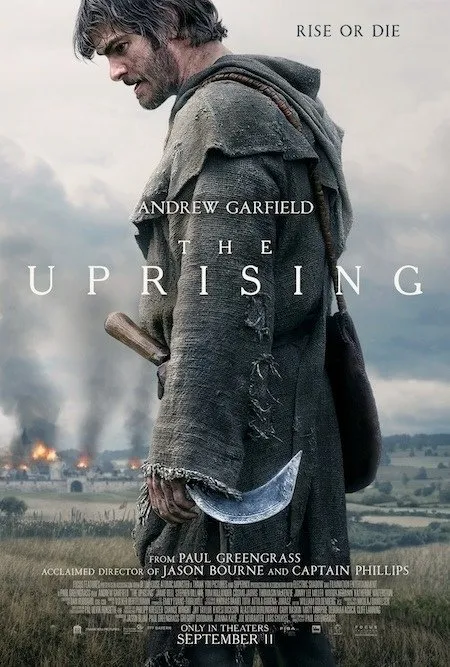
Based on the true story of the uprising that inspired the legend of Robin Hood, Andrew Garfield stars as the leader of a rebellion against the tyranny of King Richard II in a fight for justice.
Chuck says:
What with all the different big-screen adaptations of the Robin Hood legend, it’s amazing that the origin story of the most famous resident of Sherwood Forrest has never been told. Paul Greengrass rectifies that with “The Uprising,” a sound yet curiously uninspiring take on the renegade archer’s tale. Touting strong performances and impressive production values, the filmmaker does a fine job of immersing the viewer in the dour Middle Ages environment. Yet, there’s something missing in the telling of the tale, its approach perhaps more focused on the historical than the emotional which ultimately prevents it from sticking the landing.
Using the Peasants’ Revolt of 1381 as it back drop, the film focuses on a sympathetic Everyman. The Ploughman (Andrew Garfile) is a farmer who has little left to lose. Having lost his family due to the Plague that swept across Europe, he lives his life in solitude, stolidly minding his farm with little incentive. Adding to his woes are the high taxes he’s forced to pay, recently raised once more by King Richard II’s (Woody Norman) corrupt court of advisors. He’s pushed to his breaking point when a group of taxmen arrive to collect the new levy, his impulsive act of defiance sparking a local revolution that soon gains traction in other villages.
As the movement grows in size and makes its way towards London, intrigue in Richard’s court reaches a fever pitch. The boy king is nothing but a figurehead, his mother (Katherine Waterston) standing by, subtly prompting him to use the power at his disposal. Only when he finally meets the Ploughman does he decide to take a more active role in answering his subjects demands. That they seemingly have more in common than expected forges a connection between the two that could possibly lead to a peaceful resolution.
Greengrass fills out the cast of characters with a combination of those based on real-life figures and fictional constructs. John Ball (Jamie Bell) and Wat Tyler (Cosmo Jarvis), fellow revolutionaries to our hero each play significant roles in not simply propelling this movement, but in pushing and encouraging the Ploughman to become its figurehead. Meanwhile, the character of Alyce (Thomasin McKenzie) is used to represent the many women who were abused and marginalized during this time, her story a moving and poignant one that underscores the many injustices she and her ilk were forced to endure.
As is sometimes the case with Greengrass, he gets in his own way to the film’s detriment. While his use of handheld cameras to create a more intimate, immersive experience for the viewer is effective in “United 93” and “Captain Phillips,” it serves as a distraction here, as it did in “The Bourne Ultimatum.” Using the camera to put the audience in the teeth of the action is desirable when it is done unobtrusively, something the director is capable of doing. Yet, when this approach calls attention to itself, the camera bobbing and weaving, obscuring the action rather than clarifying it, the technique becomes a nausea-inducing liability that takes the viewer out of the film.
What’s most curious about the movie is its lack of inspiration. While the Ploughman is a sympathetic character, the performances across the board are good and the attention to historical detail impressive, there’s a curious lack of heart to the production. Missing is the emotional connection that made “Braveheart” so compelling, a film I couldn’t help comparing this to. In the end, “Uprising” is a movie of hits and misses, one that eventually plays like a history report with occasional highlights, rather than a compelling call to arms.
2 1/2 Stars