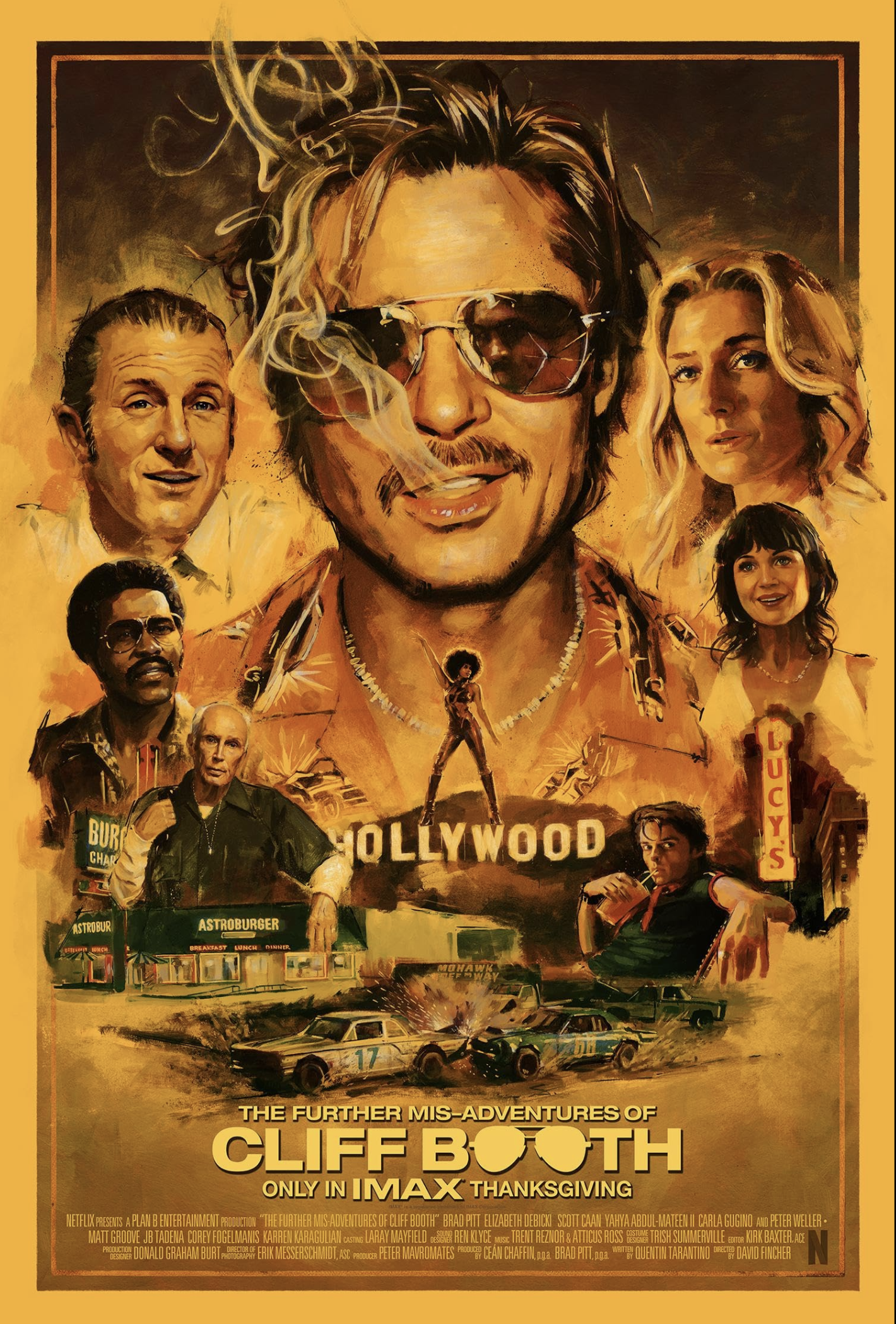
Showcases more of Cliff Booth’s backstory in his new role as a Hollywood fixer.
Pam says:
If you’re a Quentin Tarantino fan, you’ll probably want to scroll past this review. However, if you’re looking for a review that doesn’t view this filmmaker through rose-colored glasses, read on. That said, I do appreciate the stylistic components of Tarantino’s films. It’s the violence-as-entertainment aspect that has become increasingly off-putting to me, and his newest film, “ The Further Misadventures of Cliff Booth” starring Brad Pitt, continues that trend.
Directed by David Fincher, this latest iteration is a spin-off of “Once Upon a Time in Hollywood” centering on Pitt’s memorable and often comedic character, Cliff Booth. The story gives us a glimpse into Cliff’s backstory, peeling away a few layers of this hardened stuntman who, beneath his tough exterior, has a heart of gold. He is the son of Gus (Peter Weller), a cantankerous curmudgeon with whom he shares a surprisingly tender relationship. Cliff checks in on his father, looks after him, and even lovingly plants a kiss on the top of his balding head before saying goodnight. It’s a sweet moment, particularly because we don’t often see men portrayed with this kind of open affection. That relationship ultimately informs Cliff’s other connections, establishing a sense of loyalty and family among his inner circle, both blood-related and chosen.
Cliff is hired by Charlie Peters (Scott Caan), a Hollywood superstar who has landed himself in a rather self-inflicted predicament. In a drunken stupor, Peters has asked two men to kill his wife, Toni (Carla Gugino), a working actress who happens to have a history and friendship with Booth. However, in the light of day, with the married couple suddenly getting along swimmingly, Peters wants to call off the hit. He’s not exactly the brightest bulb in the box, so he brings Booth in to help him untangle the mess.
There are plenty of side stories unfolding long before we get to the crux of the film. Roderick “Hot Rod” Harrison (Yahya Abdul-Mateen II) and Karen (Elizabeth Debicki) have stories of their own, both augmenting and intersecting with those of Booth and Peters. We also get a brief scene featuring Timothy Olyphant as an actor shooting a pivotal scene. In fact, thanks to Olyphant, it is one of the best scenes in the entire film.
Pitt is, as expected, stellar as Booth. He has the presence, timing and charisma to carry a film, and this leading man does just that. The ensemble cast creates a collection of characters who could only exist in Hollywood, each adding to the film’s larger portrait of the industry. Debicki is sheer grace and beauty on screen as Karen, but the character lacks depth, much like Gugino’s Toni. Unfortunately, the female characters never quite come to life in a way that allows us to connect with them. They are present, but we never get enough insight into who they really are.
There are the makings of an interesting film here, particularly in its exploration of the camaraderie among those working in the Hollywood industry. Unfortunately, Tarantino, who penned the screenplay, takes a full hour and 20 minutes to get to the actual premise. Establishing characters and laying the groundwork for a story are important, but there is a difference between building anticipation and testing an audience’s patience. This film spends far too much time doing the latter.
And make no mistake, Tarantino makes certain we know exactly who the bad guys are. The Verdusco Brothers, played by Matt Groove and JB Tadena, are about as despicable as they come. Apparently, simply establishing them as villains isn’t enough. In one particularly disturbing sequence, the pair break into a home and violently kill two children who are running down the hallway for their lives. Blood splatters. The children are dead. Children.
We understand. These men are monsters. We aren’t going to root for them. But the graphic, unnecessary imagery serves little purpose beyond shocking the audience. It left me shaking my head and seriously contemplating the exit sign. There is a distinction between depicting violence to advance a story and using violence as a spectacle. This scene falls squarely into the latter category.
The overall screenplay is bloated and superficial, relying far too heavily on action to move the story forward. And that’s unfortunate because there is so much more beneath the surface worth exploring. At its core, this is an homage to old Hollywood, its icons and its iconic places. There are chase scenes, hot cars and beautifully composed camera shots that capture the gritty world of 1970s Los Angeles. The film’s aesthetic transports us back in time, and Fincher demonstrates a keen eye for recreating the look and feel of the era.
There is also a story here about friendship, loyalty and the bonds that turn friends into family. These are themes worth exploring, and they could have provided the film with a far more meaningful foundation. But we never get much beyond the surface. Instead, we’re given one action sequence after another, with violence repeatedly taking center stage.
I wanted more story and less bloodshed. Watching a bullet enter someone’s head, with the resulting graphic imagery presented as entertainment, ultimately diminishes the value of the lives being lost. At a time when violence is already so pervasive in the world around us, I find little entertainment in watching it exaggerated for effect.
And here’s where the film becomes particularly frustrating. With Fincher at the helm, the exaggerated, over-the-top violence typically associated with Tarantino seems to have lost some of its stylistic purpose. What remains, unfortunately, is simply the violence itself.
As Robert Redford once said, and I’m paraphrasing, “Tell a good story well.” There is a good story buried somewhere in “The Further Misadventures of Cliff Booth.” It’s just too bad we have to navigate so many unnecessary, bloody and bumpy detours to find it.
2 Stars