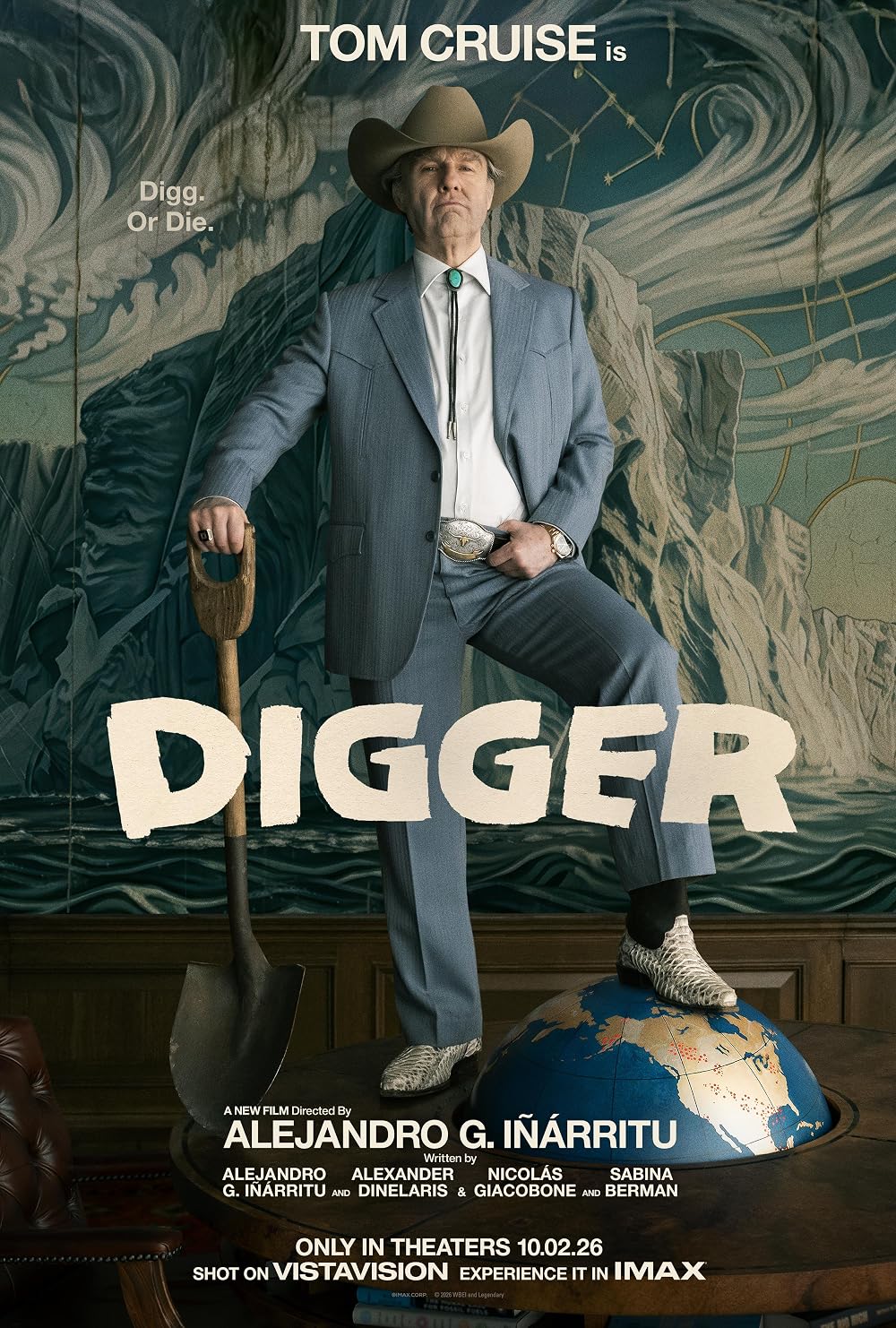
The most powerful man in the world embarks on a frantic mission to prove he is humanity’s savior before the disaster he’s unleashed destroys everything.
Chuck says:
It would be easy to dismiss Tom Cruise’s latest as Oscar bait – and let’s be honest, it is – but there’s much more at play in Alejandro G. Inarritu’s “Digger.” Brilliant and daring, this instant classic takes no prisoners in going after myriad institutions, the film a primal scream giving voice to the fear, frustration and anger directed at those who profit at the expense of us all and our planet. And yet, the movie is so much more than a broadside directed at big business, corrupt politicians and the malleable media as it also speaks to the vital nature of art and its ability to sustain us during the darkest times or heal us vicariously. It would be easy to dismiss Tom Cruise’s latest as Oscar bait – and let’s be honest, it is – but there’s much more at play in Alejandro G. Inarritu’s “Digger.” Brilliant and daring, this instant classic takes no prisoners in going after myriad institutions, the film a primal scream giving voice to the fear, frustration and anger directed at those who profit at the expense of us all and our planet. And yet, the movie is so much more than a broadside directed at big business, corrupt politicians and the malleable media as it also speaks to the vital nature of art and its ability to sustain us during the darkest times or heal us vicariously.
Digger (Cruise) is the smartest oil man in the world. Just ask him. So much so, that he has a bad habit of ignoring or browbeating into submission anyone or anything that opposes him. His arrogance ultimately results in a catastrophic disaster. Having ignored reports that methane gas rising from Greenland’s ocean floor had reached dangerous levels beneath one of his drilling platforms, he’s startled to hear that a large chunk of a nearby ice shelf has broken off as a result. Five times the size of Washington, D.C., this runaway iceberg is headed towards the coast of Norway and there’s no way to stop it.
Once alerted, the president (John Goodman) weighs blowing it into little pieces, ignoring environmental expert Dr. Ganesh’s (Riz Ahmed) warning that it will cause further dire ramifications. Yet, Digger may just have a plan to save the day, that is if he’s allowed to act and the media doesn’t blow things too far out of proportion.
And then, something happens…
It’s understood that critics will not divulge key plot points so as not to spoil any surprises any film might hold, yet it was made explicit this not occur before the “Digger” screening.
I gladly adhere to this as the impact of movie can only be truly appreciated by keeping certain things under wraps. Suffice it to say, the surprises here add a vital layer to the thematic foundation of the film, its meaning becoming more complex and impactful as a result.
The “Dr. Strangelove” of the 21st century, the movie’s satire is a broad as it is pointed, its dark humor driving home the absurdity of the world we live in. The president and his cabinet are portrayed as reactionary, out-of-touch buffoons, nearly all of them looking for opportunities to curry favor from their leader or in the case of the military leaders, bask in the reflected glory by putting the nation’s military might on display. As for big business, their corruption knows no bounds, Digger’s massive home a tribute to avarice and ego. The numerous animal trophies that decorate his home speak of his willingness to rape the environment in every way for profit. Conscience, if it ever existed, is just so much collateral damage to men like him.
As for the media, the phrase “control the narrative” is bandied about again and again. And while it is central to the story, its also applies in a post-modern sense as Inarritu is manipulating the plot in multiple ways, affecting not only how we perceive all that’s going on in the film, but commenting on the power of media in its various forms. Before all is said and done, how we each look at art, what it means to us and how we use it individually and as a society proves to be the key to “Digger’s” meaning.
The film’s cast is dynamite from top to bottom, Goodman stealing nearly every scene he’s in as the ailing and near mad president, while Michael Stuhlbarg shines as his patsy of a second-in-command. Ahmed is effective as well, his Ganesh going from being one of Digger’s cowering underlings to a man of conviction, while Sandra Huller as the title character’s sister commands our attention whenever she appears. If the film has a fault, it’s that she’s underused.
As for Cruise, this is not a stunt. What you see is an actor at the top of his game, pouring all he’s learned over the course of his career into a dynamic, layered performance. A polemic actor, there are those who will never give him his due, which is a shame. To be sure, there are some outsized moments here but they’re appropriate for the egomaniac he’s playing. A monologue before the leaders of the free world in which Digger takes responsibility for his actions while pointing out the hypocrisy of his critics, is an electrifying moment and one of the best scenes of the year. Cruise fiercely takes command and delivers not simply a grand movie moment but a diatribe that holds up a mirror to us all. And yet, it’s in the film’s quiet moments, where we see him dispense with the artifice that he truly shines.
“Digger” is the sort of film that challenges audiences and as a result, I fear positive word-of-mouth will be scarce and people will stay away. I hope that’s not the case, as the movie requires multiple viewings to take in all it has to say. Its message may be a hard one to hear yet one of the functions of art is help us process that which is difficult, Inarritu offering us that opportunity as an avenue so that we may cure what ails us. A film of our age and for the ages, “Digger” is an urgent piece of work that, with its daring, is one of the best movies of the year and one that will resonate long after its by-the-numbers competition fades from memory.
4 Stars