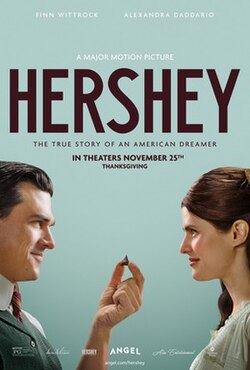
Driven by grit and relentless optimism, Milton Hershey climbs from bankruptcy to candy-making success. But when his wife falls ill, she inspires an even bolder dream: using their fortune to build a lasting legacy.
Chuck says:
The life of Milton Hershey was an extraordinary and distinctly American one. Coming from a modest background and suffering one financial hardship after another, the man held fast in his belief in his product and himself. Upon achieving great success, how he spent and continued to invest his money was the true reflection of the man, many of his deeds philanthropic in nature. He and his wife Kitty transformed a lonely piece of Pennsylvania countryside into a thriving town, its centerpiece being a school for orphaned and wayward children. The impact of their good deeds continued to have an impact on future generations, long after their deaths.
Being asked to adapt a life such as Hershey’s to the big screen has its own special set of difficulties. Figures such as this seem too good to be true and, in our cynical age, are met with skepticism. Yet Angel Studios, which seems intent on disproving the notion that “they don’t make them like they used to.” In keeping with this, they have produced “Hershey,” a well-intended biopic that, much like the studio’s recent release “Jimmy,” is the kind of film studios cranked out with regularity throughout the 30’s and into the early 40’s. It’s wholesome, at times a little bland, and brims with a quaint sense of optimism. Whether these are positive or negative qualities depends solely on the viewer. But to director Mark Waters’ credit, the film works more times than not, the core story proving to be an irresistible slice of Americana.
Said to be “based on the unlikely true story,” we see the young Milton Hershey (James Kelly) as an indefatigable go-getter, picking up odd pieces of coal around a small Pennsylvania town to earn pennies that he hordes. He hopes to buy something nice for his ailing young sister Sarena, whose untimely death at the age of four would lead to the dissolution of his family.
His mother (Francesca Faridany) and he end up living with her brother and his wife in Lancaster, when at the age of 15, he meets confectioner Joseph Royer (Richard Kind), who gives him a job in his candy store. Fascinated by the process of making a wide variety of sweets, Hershey (Finn Wittrock) becomes obsessed with making his mark on the burgeoning industry. Unfortunately, this is easier said than done. He opens two candy shops that fail and is on the brink of losing a third when he becomes reacquainted with an old family friend (Michael Moreland) who has a head for business. That they receive a massive order of their signature confection, the caramel, is the kind of lucky windfall no one would believe.
From there, the film charts Hershey’s rise to the top of the candy heap, his many foolish business practices somehow proving to be his salvation. His plants struggle to turn a profit, yet he insists on paying his employees higher wages to ensure their loyalty. He struggles for years to come up with a distinctive way to offset the bitterness of cocoa to make it palatable, nearly bankrupting the company in the process. The result is a five-cent milk chocolate bar, an affordable treat that brings what was once only for the well-to-do to the masses. This wise approach saves the company.
However, what saves the man from becoming a workaholic is Kitty (Alexandra Daddario), a precocious young woman who catches his fancy and captures his heart. Both of a generous nature, relating how the couple use their fortune for the benefit of others is when the movie hits its stride. Waters and his cast show restraint, holding back on the sentiment so as not to venture into the melodramatic, knowing the power of the narrative alone is enough to drive home its theme.
Never an easy task, the script by M. Hayes and Sharon Paul covers a great deal in a short time, yet the story never feels incomplete or lacking until the third act. Many key events in Hershey’s later life are touched on and not fully explored, leaving the viewer with questions regarding his endeavors in Cuba where he worked to ensure a steady sugar supply, and the development of the town that bares his name. A person’s life is too vast to be contained to a two-hour movie and “Hershey” stumbles due to that in the end.
Be that as it may, its wholesome, old-fashioned aesthetic and approach work in its favor as does the fine performances of the two leads. For some, “Hershey” will come off as a bit too sweet and lacking in complexity. But like the titular characters’ five-cent candy bar, this is a film for the masses, a middle-of-the-road entertainment that manages to get the job done cheaply and efficiently.
3 Stars