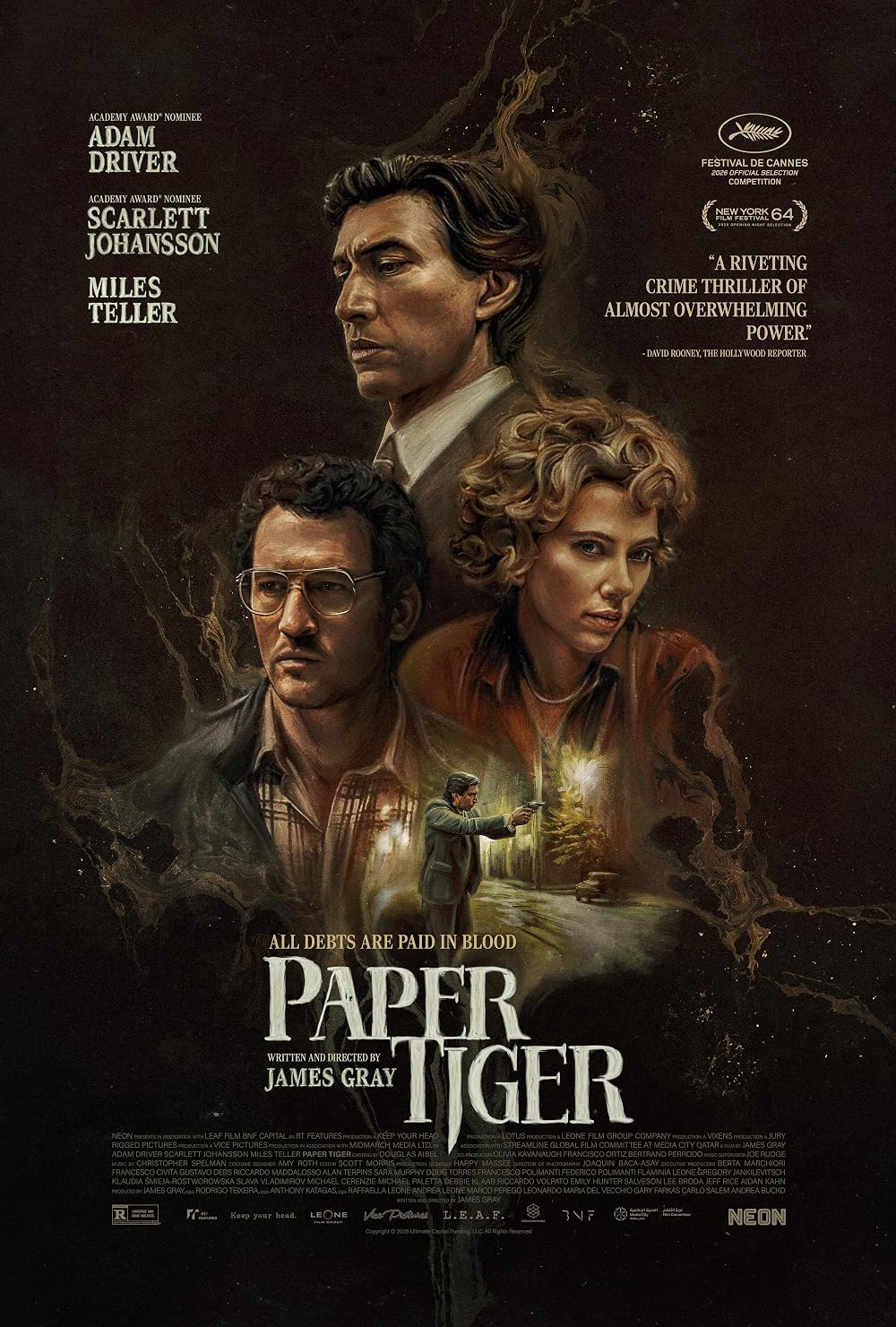
Two brothers pursue the American Dream but get entangled in a dangerous Russian mafia scheme that terrorizes their family, testing their bond as betrayal becomes possible.
Chuck says:
I’m not sure why the films of James Gray leave me cold. While many of my peers laud his New York-based films (“We Own the Night,” “Two Lovers,” “Armageddon Time”) as realistic slices of 20th-century urban life, I find my response to his movies the same as when I read Hemingway – I’m always left wanting more.
Such is the case with his latest effort, “Paper Tiger,” a somewhat engaging family drama that benefits greatly from the fine work of its three leads. Focused on a working-class family striving to get ahead, Gray’s script is the film’s greatest strength. It captures the sense of longing that comes with wanting to achieve a better standard of living as well as the low-simmering frustration that grows as it recedes in the distance. As a result, a sense of desperation – and desperate acts – develops organically in his characters, their behavior the logical outcome of a series of unfortunate events.
The time is 1986, the place is Queens, New York and the family are the Pearls. Irwin (Miles Teller), his wife, Linda (Scarlett Johansson) and their two teenage boys, Scott (Gavin Goudey) and Benjamin (Roman Engel) are a typical middle-class family. He works as an engineer, pays his bills on time and longs to move to Great Neck. His brother, Gary (Adam Driver) holds an exalted place in the clan. A former police officer, he lives a life that is seemingly made up of luxury and glamour. That it all might be a sham never occurs to his brother or nephews who are enamored by what he represents.
So, when he shows up on their doorstep, with a business proposition he’s sure will put them all on easy street, it never occurs to Irwin it might not be on the up-and-up. A new government-funded program to clean up New York’s polluted canals is about to be enforced. Gary proposes he and his brother act as a consulting firm to advise businesses on the waterways how to comply with these new regulations. It seems like a surefire money maker as most of their would be clients are members of the Russian mob who’ve made inroads in this area. Unsure of the ins-and-outs of the laws of the United States, they should be easy to manipulate.
Of course, we know what happens with best-laid plans and due to an overzealous act by Irwin, not only is the business venture in jeopardy, but so are the lives of him and his family. What ensues is a somewhat intriguing morality story in which each of the three principals find themselves between a rock-and-a-hard-place, each acting as they see best, none of them aware of the true ramifications of what they do.
While there’s a degree of predictability to the story, the acting from Driver, Teller and Johannsson is exceptional and nearly salvages the film. We’ve seen Driver in roles like this before but that doesn’t make what he does here less impressive. The actor effortlessly conveys the sense Gary cannot be trusted. A shifting of the eyes, a rushed statement, an exaggerated gesture are just a few of the tools the actor employs, while effective pauses and soulful looks are used to create a sympathetic portrait of a man who means well, his fatal flaw the willingness to overlook potential negative outcomes. Teller is just as good, giving his most mature performance to date. There’s a reserve to his work here that underscores Irwin’s everyman qualities. There’s nothing showy in what Teller’s doing, his less-is-more technique the proper approach for this common man.
As for Johannsson, the fact that she appears in so many genre films and makes what she does look easy, makes her one of our most underappreciated actresses. Honest and present in every role she takes, her challenge here is in playing a modest, sheltered, well-meaning wife and mother, the kind that has been overlooked for generations. The actress captures the kind of below-the-surface worrying that hangs over women like Linda. That she has concerns her husband is unaware of gives Johannsson more dramatic fuel to work with as she poignantly creates a common woman with uncommon concerns.
Gray is lucky to be able to attract A-List talent as they make his work seem better than it is. The writer/director wants “Paper” to be received as some sort of update of a Greek tragedy, which is an admirable goal. In the end, the film simply doesn’t have the dramatic heft to separate it from the pack. Very much like its character Gary, it goes out with a whimper rather than a bang.
2 1/2 Stars