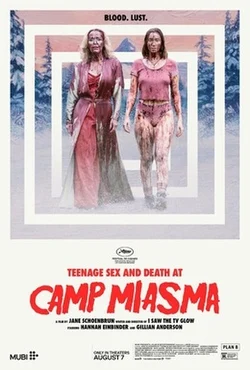
A director making a slasher sequel becomes obsessed with casting the original film’s ‘final girl,’ leading both women into psychological and sexual chaos.
Chuck says:
Like ten pounds of potatoes stuffed into a five-pound bag, Jane Schoenbrun’s “Teenage Sex and Death at Camp Miasma” is bursting with myriad themes, commentary and axes to grind. There are more than enough topics and motifs to be covered in three movies, and while all aren’t explored fully, you have to admire the writer/director’s enthusiasm for her subject. Key to the film’s success is the sense of fun generated throughout this meta-meta exercise, effectively buoyed by Gillian Anderson’s knowing performance as an actress whose on-screen persona has affected her personal life in tragic and comic ways.
Assigned with the seemingly unenviable task of rebooting an exhausted horror film franchise, writer/director Kris (Hannah Einbinder) is eager to take it on. Far too young when she saw the first “Camp Miasma” film, the young woman has been confusing sex with murder for some time. It’s no wonder, as the series’ villain, Little Death (Jack Haven), kills his sexually-active victims when they’re in the act of climaxing. That Kris has been unable to consummate any of her relationships comes as no surprise. Her interest in making yet another “Miasma” movie hinges on her desire to unravel this psychological conundrum and meet Billy (Anderson), the actress from the first film she’s been vicariously connected to since seeing her on screen.
Anderson, armed with a seductive southern accent and the bearing of an exiled royal, is obviously having a good time channeling Gloria Swanson. Living in seclusion on the set of the first “Miasma” movie, Billy is obviously modeled after Norma Desmond, her life frozen in time as she’s abandoned the real world, having given herself over to the movie environment where she found a fleeting bit of success.
Obvious allusions to the “Friday the 13th” franchise as well as numerous other horror films are bandied about, while a variety of genre tropes are put under the microscope. More importantly, Schoenbrun addresses the knotted connection between sex and violence that has always been part-and-parcel of the horror film. The connection between these two acts became even more complex with the explicit nature of their convergence with every post-“Psycho” feature. The alternate meaning to Little Death’s name is telling as is the way in which Schoenbrun recreates the killings in the “Miasma” movies. The male gaze, which young Kris falls victim to while watching the franchise entries, is upended while issues of gender representations in the genre are examined as well. That some are delved into more than others is no surprise as these complex issues yield a variety of responses related to various other concerns that would prompt further discussion.
Also telling is the movie’s evolving visual aesthetic. Kris’ journey to Camp Miasma seems to begin in the real world but the longer she resides there, the more we see it through her eyes. As the film progresses, it becomes more stylized, the artifice of a film set not hidden but exaggerated. The character’s inability to move past the trauma of seeing the “Miasma” movie has consumed her and we become immeshed in the trap as well. Soon, garishly colored buildings, painted backgrounds and artificial building fronts fill the frame, Kris’ “world view” stemming from the movie environment she can’t move past.
While this may sound like heavy lifting, the film is actually a delight, Schoenbrun deftly weaving a tongue-in-cheek irony into her serious deconstructive approach. While knowledge of horror movies, slasher flicks particularly, is beneficial to all the director is addressing, it’s not vital where understanding Kris’ journey is concerned. If nothing else, there are the performances to enjoy, Einbinder’s over-earnest take clashing comically with Anderson’s camp turn. Whenever the film begins the bog down, this dynamic pair saves it.
The question becomes whether or not Kris will opt to stay in Billy’s limited but somewhat safe world or if she’ll be able to pull her idol from her self-imposed exile. “Miasma” speaks to the seductive and overwhelming power of the cinema, as well as the damage it can impose, the advice in Schoenbrun’s cautionary tale easier and more enjoyable to ignore than embrace.
3 1/2 Stars