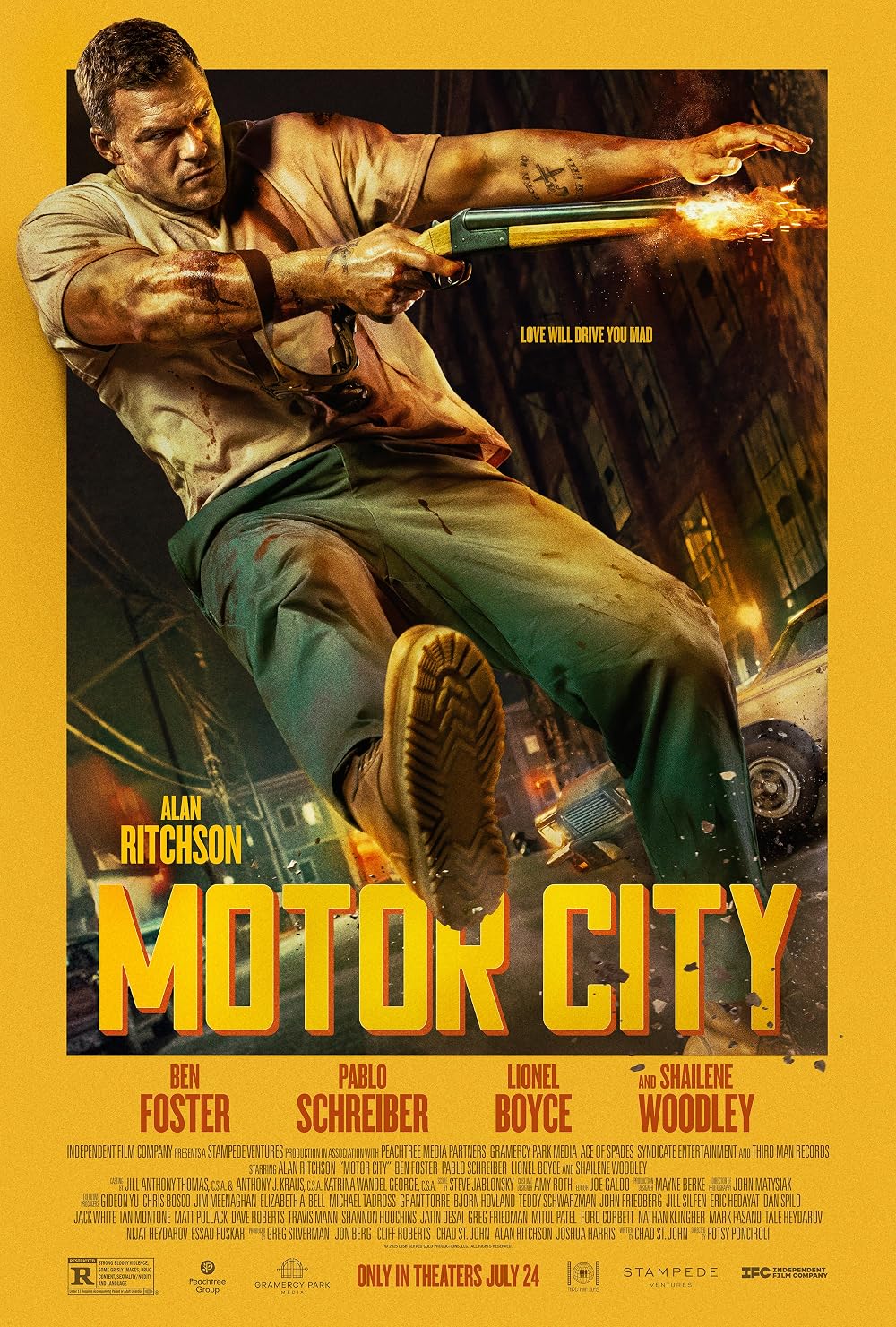
In 1970s Detroit, John Miller falls for a local gangster’s girl. In retaliation, the gangster enacts a frame job to send the innocent man to prison. Life ruined, Miller plots a revenge campaign against the man who took his girl away.
Chuck says:
A highly stylized experiment, Potsy Ponciroli’s “Motor City” takes a standard revenge plot and gives it new life by omitting nearly all dialogue between its characters. Much like “In a Violent Nature” (2024), a slasher film with no music soundtrack, the omission of a narrative element we’ve come to take for granted requires the viewer to see the film in a different light. It seems like a small adjustment but it makes a big difference as we find ourselves more conscious of the visual elements and minimalist acting on display. Fortunately, Ponciroli has the chops to frame and choreograph one arresting image and sequence after another while his cast is up to the task of getting more out of doing less.
Knowing complex plot twists would be hard to convey, Chad St. John’s script is a model of simplicity. Ex-con, current auto worker John Miller (Alan Ritchson) has been set up by the nefarious gangster Reynolds (Ben Foster), his minions having planted a large cache of cocaine in his car. His ex, Sophia (Shailene Woodley) is engaged to the big lug and the best way to get him out of the way is to make sure he has a long stay in the Crossbar Hotel. Constantly abused by the guards in Reynolds’ employ, Miller stews in stir, plotting a grand revenge while Sophia, who forgets about him a bit too quickly, indulges in the high life her new old partner can provide.
Playing like a series of music videos, “Motor” comes off as a visual record album, each cut a mini vignette, all strung together as a narrative whole. While not an original concept, the film holds together, executed so well you soon forget about the gimmick and get sucked into the operatic nature of the story.
Taking place in the mid 1970’s, the soundtrack is of that era, the various moods of each scene ultimately resulting in an eclectic mix. Bill Wither’s “Lovely Day” plays beneath the moment Miller proposes to Sophia, David Bowie’s “Cat People” (Putting Out Fire) propels one of the many action sequences, while Fleetwood Mac’s “The Chain” plays beneath Miller’s arrest, conveying the long-term consequences of this action. Stephan Jablonsky’s score provides a seamless bridge between the pop hits, the cumulative effect proving hypnotic yet never obtrusive.
Working with cinematographer John Matiysiak, Ponciroli composes one arresting image after another. Most refreshing is his ability to allow his camera to dwell on the well-choreographed action sequences. Eschewing the oft-used combination of close-ups, quick camera pans, and hyper-kinetic editing, the director instead holds on the movement in the frame longer and employs far fewer cuts over the course of a sequence. This results in set pieces that are much easier to follow and appreciate, the use of slow-motion used with restraint to, at times, underscore the impact of the destruction Miller and Reynolds are inflicting upon each other.
The highly stylized, gritty urban aesthetic creates a distinctive environment reminiscent of Walter Hill’s “Streets of Fire” (1984) and, to some degree, Frank Miller’s “Sin City” (2005). The battered muscle cars that rumble over the cracked streets, the weather-decayed buildings, the rust-laden prison and grease-spattered diners contribute to a cumulative feeling of rot and despair. And while the characters desperately try to find some sort of salvation within, they can’t help but be affected by their surroundings. The sordid nature of this world ultimately seeps into their bones, corrupting and skewing their moral compasses, their actions becoming more and more abhorrent. It comes as no surprise that ultimately none of the three principals recognize the person looking back at them in the mirror.
Sure to be a cult favorite in years to come, “Motor City” pulls off an interesting highwire act, emphasizing film fundamentals over computer wizardry, creating analog images and utilizing in-camera special effects to, ironically, create a fresh look at a worn-out genre. Unlike most modern action films, “City” left me invigorated rather than exhausted, Ponciroli’s old-school approach a reminder that often times, especially where filmmaking is concerned, less is more.
3 Stars