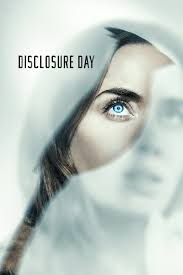
If you found out we weren’t alone, if someone showed you, proved it to you, would that frighten you?
Chuck says:
A miscalculation on multiple levels, Steven Spielberg’s “Disclosure Day” proves to be the biggest cinematic disappointment of the year so far. Granted, this reaction hinges on the high expectations generated by the director returning to the genre in which he’s made some of his finest films. Many of the director’s trademark narrative elements are in place and he hasn’t lost a step where putting together imaginative action sequences are concerned or effectively injecting life into a story with his often inconspicuous camera moves. Yet, the script by the usually reliable David Koepp is a burdensome beast, an incident-laden construct that’s bogged down by redundant action, all the while introducing intriguing thematic questions that are never fully developed or answered. The result is a tedious slog to a magical ending, the film’s final 15 minutes the sort of wonder-filled filmmaking we’ve come to expect from Spielberg, cropping up far too late.
The movie begins mid-action as we see Dr. Daniel Kellner (Josh O’Connor) in a bit of a pickle. Having stolen sensitive information from a secret government agency, he’s confronted by his former boss, Noah Scanlon (Colin Firth) and his many armed minions. Seems they’ve taken his girlfriend, Jane (Eve Hewson) hostage and are willing to free her as long as he returns what he’s taken. It would have been an awful short movie had Kellner complied so it comes as no surprise that he and Jane make their escape, setting up a chase that takes them halfway across the country.
Meanwhile, meteorologist Margaret Fairchild (Emily Blunt) is having issues of her own. While on the air at a Kansas City news station, she begins speaking an indecipherable language consisting of mostly clicking and clacking noises. Even more peculiar, she’s suddenly able to look at someone and see their past as well as tell what they’re thinking. Needless to say, this gets the attention of Scanlon, who sends out agents to bring her in. With her newfound abilities, she’s able to tell she’s in danger, so she and her boyfriend, Jackson (Wyatt Russell) – you guessed it – escape and they too are now on the run.
Structurally, there’s nothing inherently wrong with the chase film. Spielberg’s “Minority Report” is one of the best in this action sub-genre. But unlike that underrated classic, “Disclosure” does little in the way to keep us hooked. Repeated narrow escapes are rote exercises while far too many key elements are vaguely rendered. Just how Fairchild is able to do what she does – and so much more – is frustratingly ambiguous, the ultimate explanation offering little insight. Kellner’s intentions are sound but he’s a one-note character who desperately needs more of a back story or at least some shades of gray.
These flaws would be excusable were the movie simply more compelling. I would have never suspected tedium would set in during a Spielberg movie. The film spins its wheels, introducing ideas and then abandoning them. Whilst these parallel chases are occurring, World War III is about to break out as tensions rise between the United States, Russia and Korea. One would think this event would have a major impact on the story but here it’s just so much background noise.
Also overlooked are the ripple effects of Kellner’s actions. He stole video evidence showing the United States has had numerous interactions with extraterrestrials since the Roswell incident in 1947 with the intention of sharing it with the world. He and others mention the vast ramifications involving religious beliefs, societal interactions, man’s existential dilemma and a variety of other issues, if he succeeds. None of these vital issues are expanded upon.
And therein lies the film’s fatal flaw. Spielberg and Koepp tell the wrong story. “Disclosure Day” is simply one long slog to the inevitable that ends right where it should have begun. Speculating how the world would change once this bombshell drops would have been far more interesting than the film’s two mundane chases and this is all the more frustrating thanks to Spielberg’s astonishingly moving climax. As the stolen clips are played for the world to see, we witness wondrous, peaceful interactions between humans and aliens, the end result being an aching hope that once these events actually occur, they will serve as a bridge towards greater understanding and compassion for others as well as those like us.
Perhaps the film’s most intriguing thought is Kellner believes that our decreasing lack of empathy as a species is preventing us from evolving. It’s a quaint notion yet it has merit and couldn’t be timelier. In this age of disinformation, Spielberg’s message is that it’s viral that we truly listen to one another, speak the truth without fear of reprisals and are able to accept it without suspicion. Had the film progressed to provide examples of this after Kellner’s revelations were made, “Disclosure” might have been, like the director’s best work, a vital message of hope.
2 Stars