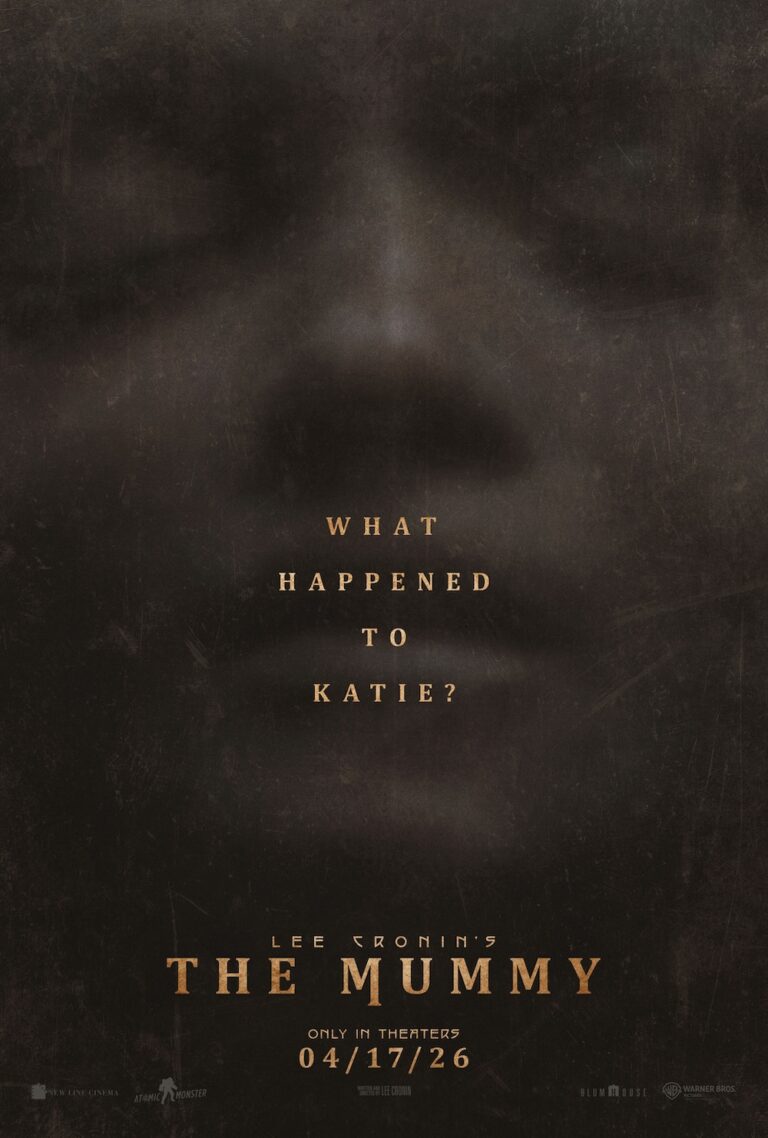
The young daughter of a journalist disappears into the desert without a trace. Eight years later, the broken family is shocked when she is returned to them, as what should be a joyful reunion turns into a living nightmare.
Chuck says:
A brilliant reimagining of one of horrors seminal creations, “Lee Cronin’s The Mummy” is a genuinely disturbing new film that manages to succeed where so many recent genre entries have failed. In modeling the film after “The Exorcist,” the director hones in on every parent’s worst nightmare, exploiting it to maximum effect, resulting in a sense of intimacy and identification upon which its terror is built. Anchored by two strong lead performances, the movie cuts deeper than usual horror fare, the emotional buttons Cronin pushes throughout making for a deeply disturbing and ultimately poignant film that proves hard to shake after its draining climax.
Working in Cairo, Egypt, as an international correspondent, Charlie Cannon (Jack Reynor) is on the verge of great things. Having just secured a job with a major network in New York City, he, his wife Larissa (Laia Costa) and their two children are about to head back to the States. However, tragedy strikes when their eight-year-old daughter Katie (Natalie Grace) goes missing. There are few leads to follow and the authorities prove uncooperative.
Having relocated to Albuquerque, the family has found its footing after nearly eight years, the addition of the daughter Maude (Billie Roy), a help. That is all disrupted when a call comes from the Cairo authorities with news that Katie has been found in the most unlikely of places. Discovered alive in a centuries-old sarcophagus, the young girl is no longer who she was. Though her body has not grown, her skin is withered and scaly, her limbs are misshapen, as is her face, a catatonic look across it. That she is nonverbal only adds to the mystery of what has befallen her.
Much is revealed once the action shifts to the States where strange goings-on occur. Katie shows unusual strength, has a tendency to bite and likes to headbutt anyone who comes too close. And after a pedicure gone horribly wrong tears a long piece of skin from her leg, the first clue is revealed as to what she really is.
Cronin’s use of body horror in “Evil Dead Rise” was gratuitous, yet here it serves a purpose. This film is not for the easily squeamish, as numerous scenes contain moments of physical mutilation. However, many of them prove to be key elements where unraveling this mystery is concerned, one key point an ingenious twist on a trope from the mummy movies.
While the traditional horror scenes are slickly executed and effective, the film is most effective in its examination of the Cannon family unit. Reynor and Costa are exceptional in conveying the hopelessness they feel in being unable to care for their daughter. Not only are they reluctant to admit Katie has special needs they cannot address, but also that their feelings have changed towards her. This will hit home with anyone who’s had to care for a loved one altered by disease or an accident.
The revelation of what happened to Katie is the most horrific moment in this, or any horror film I’ve seen in recent memory. The feelings of helplessness Charlie and Larissa feel as they watch their child abused cuts to a primal fear “The Mummy” focuses on to great effect. This is far more than simply a monster movie; it’s the nightmare at the center of the collection of fears every parent has, writ large on the screen, the one that sneaks through when are defenses are down, our doubts paramount. Ultimately, parental sacrifice is revealed at its theme, driven home by the film’s final, haunting moment, a moving reminder of the need to cherish that which we hold most dear.
3 1/2 Stars