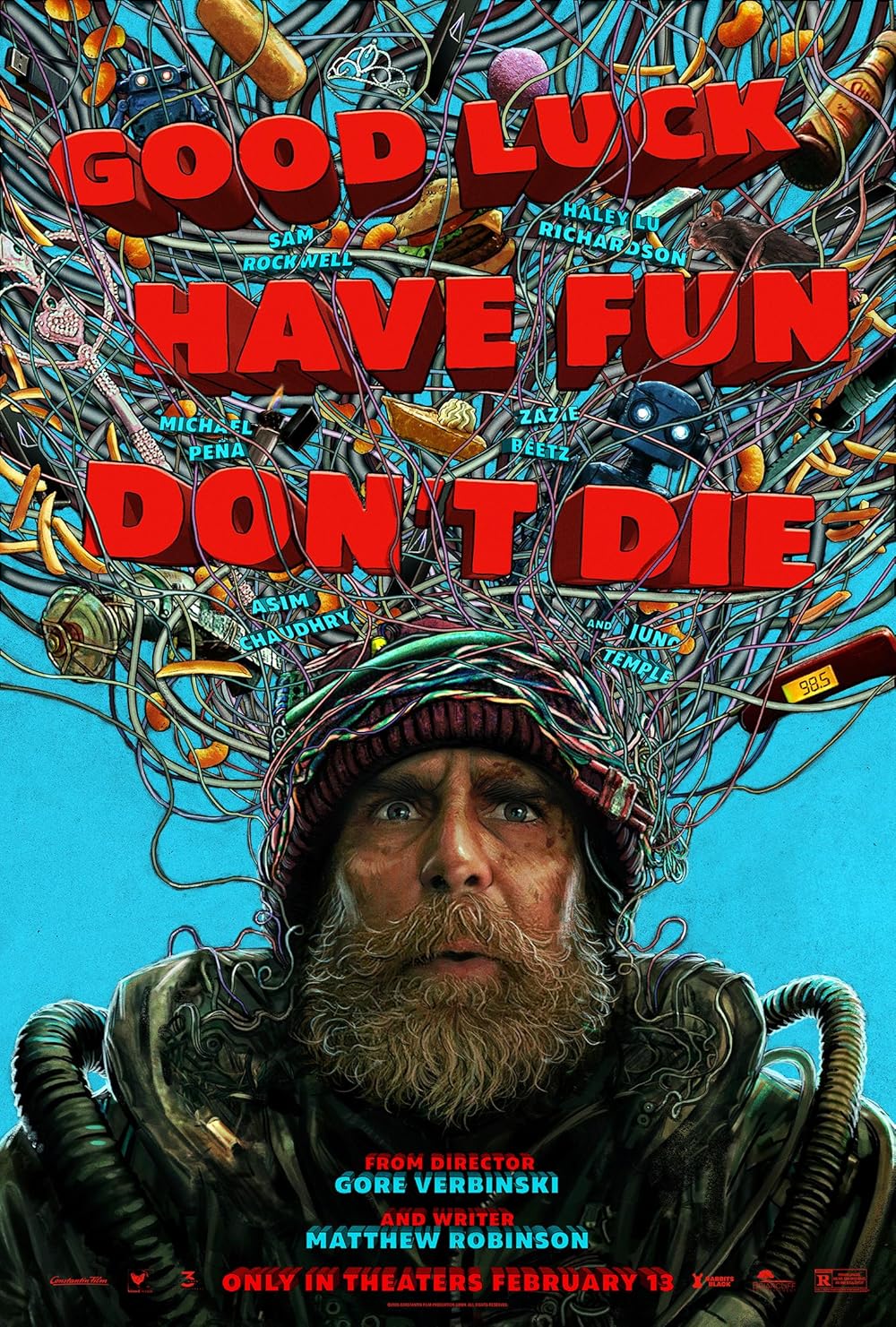
A “Man from the Future” arrives at a diner in Los Angeles where he must recruit the precise combination of disgruntled patrons to join him on a one-night quest to save the world from the terminal threat of a rogue artificial intelligence.
Chuck says:
Watching Gore Verbinski’s “Good Luck, Have Fun, Don’t Die,” proved to be one of the most whiplash-inducing filmgoing experiences I’ve had in quite some time. Initially engaged by its intriguing time travel premise and the captivating, manic performance by Sam Rockwell, I found a second act revelation so repellant, it took me completely out of the movie. That it was able to hook me once more was due to the impassioned performance by Haley Lu Richardson, who’s character enters the spotlight in the later half. Yet, upon seeing it a second time, while my objections to it remained, its ultimate thematic purpose won me over, as did Matthew Robinson’s script which dares to confront pressing societal issues most turn a blind eye to.
Things start off with a bang as a Man from the Future (Rockwell) barges into a Los Angeles diner, disrupting its late-night patrons. He claims this is his 117th time living through this particular evening, as the dire happenings of his own era compel him to travel back in time to alter history. Seems there’s a young boy in the area who is creating an AI program that will ultimately take over the world. All the man wants to do is instill some software containing safeguards that will prevent that from happening. A relatively simple assignment, one would think, but it winds up being fraught with peril.
The man contends he’s yet to pull together the right combination of people from amongst the patrons to complete his mission. After quelling their disbelief, he convinces Susan (Juno Temple), Mark (Michael Pena), Janet (Zazie Beetz) and Scott (Asim Chaudhry) to come with him. At the last minute, he impulsively enlists Ingrid (Richardson) as well.
As the night plays out, flashbacks provide background for the key players. Mark and Janet are high school teachers, their students’ lives overtaken by social media. Inadvertently, they’ve triggered an app that turns their young charges into zombies. Ingrid, who happens to literally be allergic to wi-fi and cellphones, has recently lost her boyfriend to AI. He has voluntarily entered into a sleep pod where he will be constantly fed a series of images of a “better world.” Janet, is the most tragic of the lot, her son having been killed in a school shooting. This has become such a common occurrence that parents have their slain children cloned, a process partially funded by the government. Out of necessity, she opted for a model that comes with ads, her “son” randomly speaking of a favorite drink he’s promoting.
Robinson’s nightmarish vision of the future bares more than a passing resemblance to The Matrix. Yet, his folding in of more concrete issues makes it more relevant and powerful. The conceit that AI and social media will rob us all of our humanity is taken to horrific extremes, particularly where the issue of school shootings is concerned. That the parents of the slain can so flippantly talk about manipulating the most recent clone of their child so they’ll be “funnier” or “not as uptight” speaks to the callousness that develops through lack of human interaction. On the surface, this seems ridiculous yet we see examples everyday of unfeeling behavior in government and our neighborhoods, adding weigh to the argument.
That the souls of the younger generations are in danger of being subsumed by social media is a reality that’s playing out before our eyes. That high schoolers are portrayed as an army of zombies is spot on, as is the idea that we can no longer believe in everything we see. One of the most intriguing and entertaining aspects of the film is that anything that can be thought of can be brought into being and that perhaps none of what we see is actually real. All stops are pulled during the climax, as we’re bombarded with one striking image after another, the vision of one character beaten back by a whirling maelstrom of wires and gadgets one I won’t soon forget.
There are times when the story sags and I think Verbinski is aware he’s overloading the audience with too much information at times. As a result, he keeps the story moving from one event after another, pushing the viewer from one mind-bending moment to the next, not allowing us time to digest all we’ve seen and heard. Still, there’s no denying the film’s propulsive energy, provided primarily by Rockwell, whose manic persona is perfectly suited for the film. Equally impressive is the always-reliable Richardson, her displays of vulnerability and selflessness providing a necessary emotional hook.
A cult movie in the making, Gore Verbinski’s “Good Luck, Have Fun, Don’t Die,” benefits from multiple viewings. Narratively dense and frantically paced, you’re likely to catch things when re-watching that slipped by you, many of which put aspects of the story in a new light. And while this cautionary tale is well done, I fear it’s message will be lost in the vast sea of meaningless media that constantly buffets us. “Good’s” warning isn’t prescient, but rather its dystopian scenario has already come to be. We’re just too distracted to see it.
3 1/2 Stars
Pam says:
Bizarre, darkly funny, and uncomfortably topical, “Good Luck, Have Fun, Don’t Die” imagines a future that feels a little too plausible. Sam Rockwell plays a man known only as “Man from the Future” who crashes into our present day, specifically, into a late-night diner filled with strangers. He’s been here before, though, to this exact moment in time. In fact, he’s been here 117 times. Each of his visits is another attempt to assemble the right combination of people willing to help him prevent a catastrophic future.
The potential saviors are a ragtag mix: Janet and Mark, married high school teachers played by Zazie Beetz and Michael Peña; Susan, an eccentric outsider portrayed by Juno Temple; Ingrid, a princess-costumed wildcard played by Haley Lu Richardson; and several other seemingly expendable patrons. Yet each person carries a backstory that explains why they are in this diner, on this night, at this precise moment in time.
Half the fun lies in watching Rockwell’s character attempt to convince this skeptical group that he truly is from the future. The other half unfolds as they embark on a mission to identify, and most importantly, to stop the individual responsible for humanity’s downfall within the next fifty years.
The film balances bursts of violence with sharp social commentary, often inviting uneasy laughter as we zip back in time to learn more about each of these characters. The story keeps you guessing while holding up an unsettling mirror to our present day choices. The ensemble delivers exactly what you would expect from a cast of this caliber: layered, committed, and deeply engaging performances. And the ending lingers as it’s provocative, unsettling, and difficult to shake. Is this really our future? And more importantly, is it closer than we think?
“Good Luck, Have Fun, Don’t Die” is a bold statement disguised as a genre mashup, taking viewers on an unexpected ride that may make you reconsider more than just your next late-night diner visit. In fact, instead of doing “dinner and a movie,” make it the reverse; movie and then dinner because you’re going to want to discuss what you’ve just seen.
3 1/2 stars