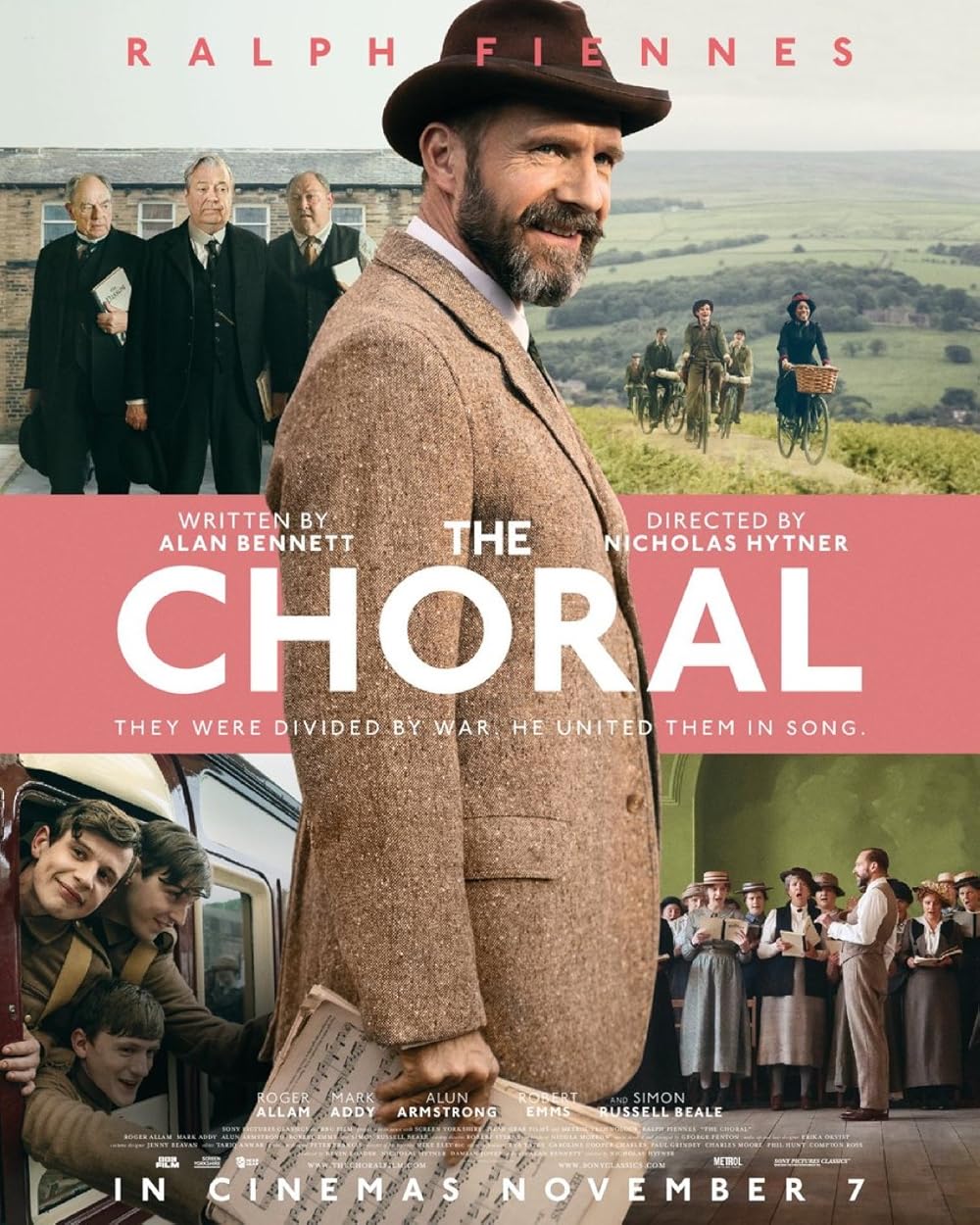
A choral society’s male members enlist in World War I, leaving the demanding Dr. Guthrie to recruit teenagers. Together, they experience the joy of singing while the young boys grapple with their impending conscription into the army.
Chuck says:
Possessing good intentions can sometimes compensate for other faults and such is the case with Nicholas Hytner’s “The Choral.” This tale, set in an English town grappling with the ramifications of World War I, brims with moral conundrums and far too many plotlines. Yet, the skill with which the story is executed and the deft touch applied by Hytner and his cast help negate the film’s shortcomings, providing genuine sentiment to what could easily become a cloying, melodramatic exercise.
Like some many English communities, the Yorkshire town of Ramsden has seen an inordinate amount of its young men go off to fight in “The Great War.” Among them is the choir master, leaving the board of the Ramsden Church, Bernard Duxbury (Roger Allam), Joe Fytton (Mark Addy) and Herbert Trickett (Alun Armstrong), grasping at straws. In desperation, they hire Henry Guthrie (Ralph Fiennes) to take over their annual production of Bach’s “St. Matthew Passion.” This proves problematic, as the conductor has just returned from Germany, where he spent years studying their music and culture. His homosexuality doesn’t sit well with most of the conservative community either. That the group will be performing a German work is yet another bump in the road.
Less than impressed with the quality of the voices he’s inherited, Guthrie sets out to recruit some new members. His visit to the local veteran’s hospital, where those wounded and rendered infirm by the war are staying, raises some eyebrows but proves fruitful. He also decides the choir will perform Elgar’s “The Dream of Gerontius,” though the locals object to the composer’s Catholic background.
An entire film could be made solely about Guthrie and his battles, but screenwriter Alan Bennett has quite a few other narrative fish to fry. Young Bella (Emily Fairn), thinking her MIA beau has been killed, falls for one of her choirmates. However, when Clyde (Jacob Dudman) comes knocking on her door, complications ensue. The group’s gay pianist, Robert (Robert Emms) is ridiculed for registering as a conscientious objector, while three of the group’s younger members (Jacob Dudman, Shaun Thomas, Taylor Uttley) each take a different approach to their impending conscription. Then there’s the issue of if Elgar will give permission for his work to be performed…
Obviously, there are a lot of moving parts, so many that most never seem fully developed. The majority of the plotlines seem truncated or wrapped up too quickly, each requiring another scene or two in order to be fully satisfying.
Yet, there’s a reverence in the way the material is rendered that for the most part, trumps these concerns. Fiennes provides a solid center for these characters to orbit around and, as expected, his nuanced turn holds it all together. Few can convey as much as he can by doing so little. In his hands, a glance or gesture is weighted with meaning, none of it done in a grand or self-conscious manner. A scene in which Guthrie is informed the German ship his lover was assigned to has been sunk, the choir members cheering this news, he stoically dealing with his heartbreak, is among his finest moments.
While the film may have benefitted from a slightly more overt dose of emotion and more fully developed subplots, the innate power of its story is undeniable. The lessons contained in “The Choral” may seem obvious, yet it’s glaringly obvious they still need to be taught. Thanks to Fiennes and company, they hit just the right notes to drive it home.
3 Stars