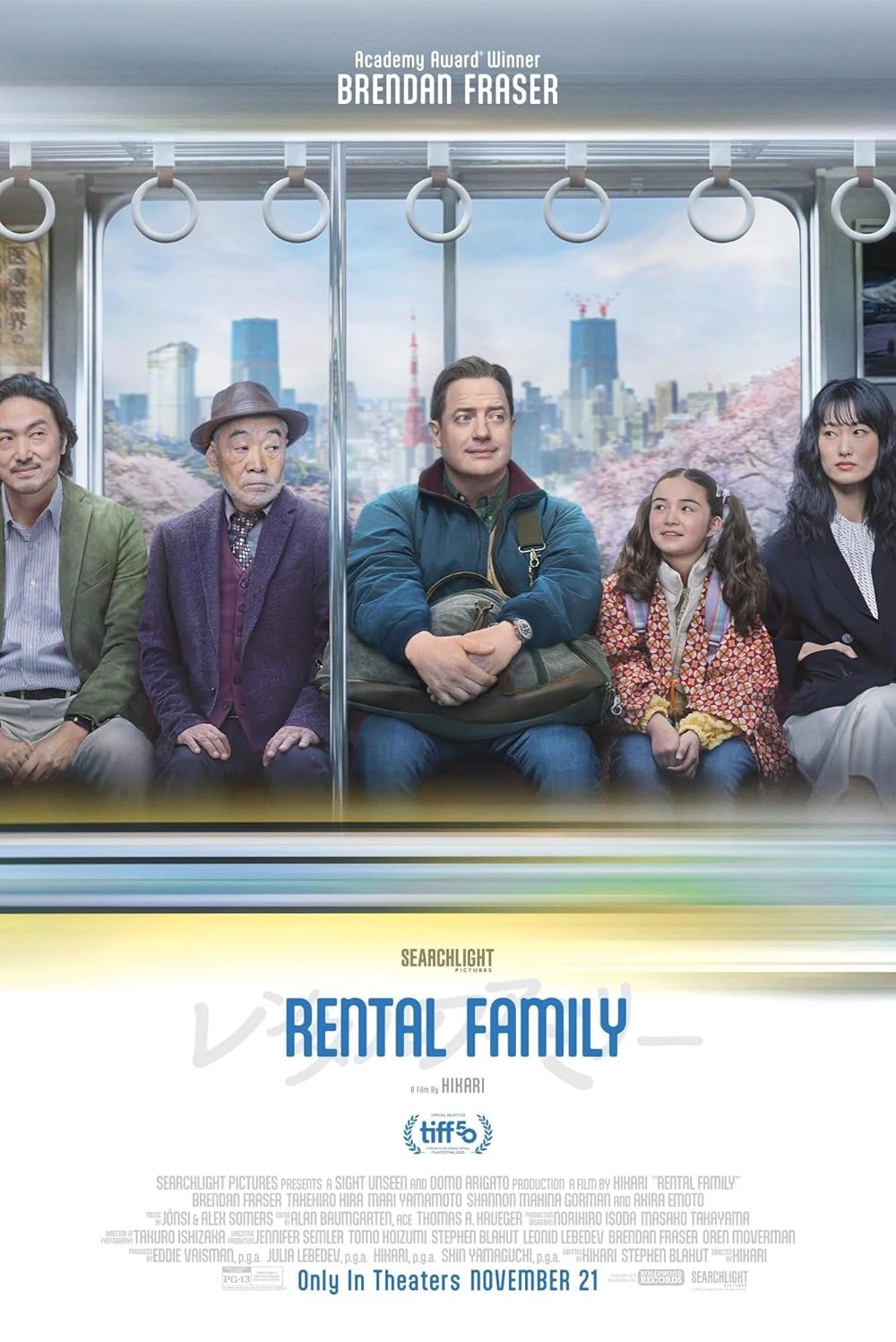
An American actor in Tokyo struggling to find purpose lands an unusual gig: working for a Japanese “rental family” agency, playing stand-in roles for strangers. He rediscovers purpose, belonging, and the beauty of human connection.
Chuck says:
Phillip seems content to drift along. An American actor in Tokyo, he came to the country to star in a series of toothpaste commercials and, with no family back home, decided to stay. Seven years on, his career hasn’t progressed, and he’s failed to make any meaningful personal connections. He seems just fine with that. Then again, you can’t miss what you never had so he goes from one meaningless gig to the next, walking daily among other lonely souls, oblivious to their solitude, content to wallow in his own. That is, until an opportunity falls in his lap that dramatically show him what he’s been missing.
Phillip is the focal point of Hikari’s “Rental Family,” a deftly rendered character study that also serves as a social commentary on the international loneliness epidemic that’s taken hold. While the internet and social media were touted as tools that would bring us closer, the opposite has occurred. Isolation has become the preferred mode of existence for the young, as social interactions are avoided like the plague, true intimacy a casualty of technological advancements. “Family” proves a gentle and effective reminder of its value.
Used as a therapeutic tool, Shinji Tada (Takehiro Hira) owns a rental family agency. He provides actors to stand in as close friends or family members, role playing in situations his clients find to be therapeutic. Phillip stumbles upon this agency, is hired as the token American and soon finds himself performing a wide variety of roles. Among the most important is that of pretending to be the father to a young girl named Mia (Shannon Mahina Gorman). Her single mother needs him to complete the illusion her daughter comes from a stable family so she can get into a private school. Phillip’s other major client is Kikuo (Akira Emoto), a former film actor. His daughter has hired him to pretend to be a reporter sent to interview the old man to write a retrospective of his work.
As one would imagine, the lines begin to blur for our hero and he soon begins forging emotional bonds with both of his subjects. His having to leave Mia once his job is done, the girl firmly believing he is her father, is heartrending. His connection with Kikuo proves more immediately beneficial as he helps him unearth memories of a past love he hoped to find before the dementia he’s battling takes its toll.
The success of the movie relies heavily on the inherent appeal of its lead. Likable and vulnerable, Fraser is the perfect choice for Phillip, the actor’s unassuming nature complimenting his character’s easy-going demeanor. The sympathy we feel for him is immediate, as is our desire he find some degree of happiness.
As the film progresses it seems as if Hikari and her co-writer Stephan Blahut have written themselves into a corner. We assume that once the ruse is exposed, emotional calamity will ensue on both fronts. However, something surprisingly genuine emerges when Phillip comes clean, the make-believe bonds he’s formed with Mia and Kikuo managing to transcend the subterfuge that created them. It requires a deft touch and the potential insincerity of each moment is trumped by the actors’ sincerity.
Some will dismiss “Family” as contrived, naïve and sappy. It would be hard to argue against these charges yet the optimism of and need for its message outweighs these concerns. Depending on how you see the proverbial half-filled (or is it half-empty?) glass of water will determine whether you accept the gift Hikari has to offer or brush it aside as an insincere, manipulative exercise.
3 Stars